
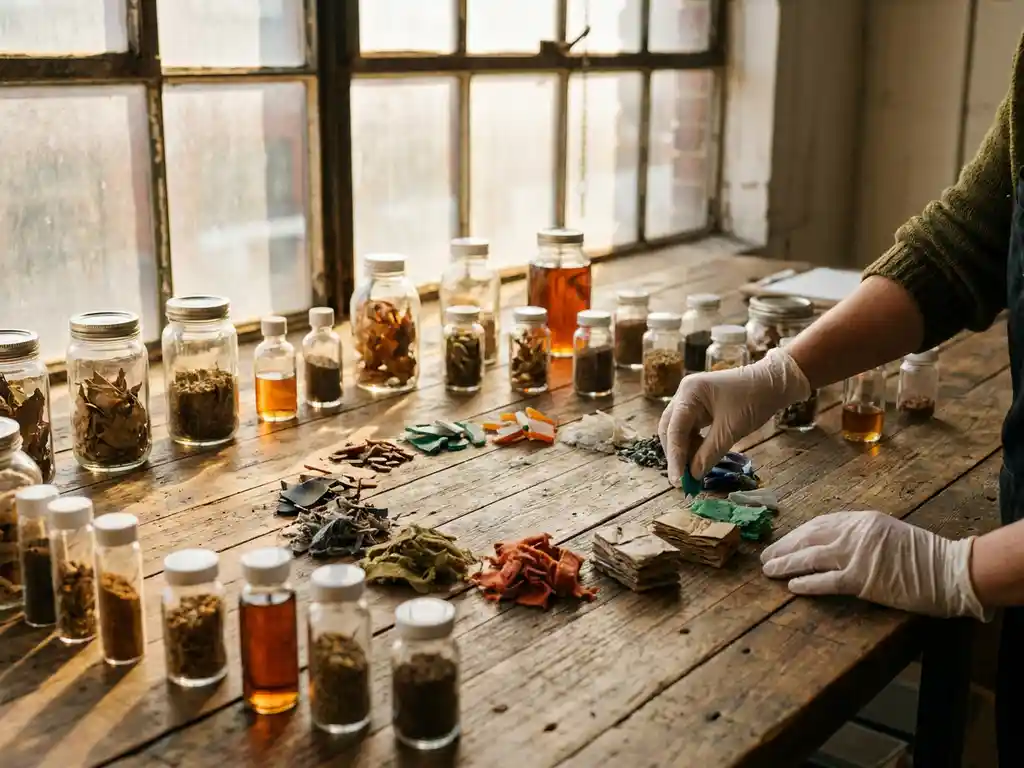
Circular economy research is the scientific study of closed-loop systems in which materials and resources are continuously reused, recycled, or regenerated rather than discarded as waste. This research focuses on developing methods, technologies, and strategies that minimize resource consumption while maximizing value retention throughout product lifecycles, supporting sustainable economic models that decouple growth from environmental degradation.
Traditional linear research models limit breakthrough solutions
Most environmental research still follows linear thinking, studying problems in isolation rather than examining interconnected systems. This approach misses critical feedback loops and unintended consequences that occur when solutions are implemented at scale. Researchers who study waste reduction without considering material flows, energy systems, and economic incentives often develop solutions that work in the lab but fail in real-world applications. To address complex sustainability challenges, researchers need to adopt systems thinking that examines how materials, energy, and information flow through entire value chains.
Fragmented research efforts are slowing progress on global sustainability goals
Individual research institutions working in silos cannot tackle the interconnected nature of circular economy challenges. When universities, companies, and government labs pursue separate agendas without coordination, they duplicate efforts and miss opportunities for breakthrough innovations that require cross-sector collaboration. The most impactful circular economy solutions emerge when diverse expertise combines materials science, economics, policy research, and social and behavioral studies. Building collaborative networks and sharing research methodologies accelerates progress toward sustainable development targets.
What is circular economy research and why does it matter?
Circular economy research examines how to design economic systems that eliminate waste by keeping materials in continuous use. It matters because linear “take-make-dispose” models are depleting natural resources and creating environmental crises that threaten economic stability and human well-being.
This research field addresses fundamental questions about resource flows, product design, and system optimization. Researchers study how materials can be continuously cycled through production and consumption processes without losing value or function. They examine business models that prioritize service delivery over product ownership, investigate technologies for material recovery and regeneration, and analyze policy frameworks that incentivize circular practices.
The urgency comes from mounting evidence that current consumption patterns are unsustainable. Global material extraction has quadrupled since 1970, while recycling rates remain below 10% for most materials. Circular economy research provides pathways to decouple economic growth from resource consumption, creating prosperity while staying within planetary boundaries.
How does circular economy research differ from traditional environmental research?
Circular economy research takes a systems approach that examines entire value chains and material flows, while traditional environmental research often focuses on single issues, such as pollution control or waste treatment, in isolation.
Traditional environmental research typically studies problems after they occur, developing end-of-pipe solutions such as filters, treatment facilities, or cleanup technologies. Circular economy research works upstream, redesigning systems to prevent problems from arising. Instead of asking how to treat contaminated water, circular economy researchers ask how to design industrial processes that never create contamination.
The methodological differences are significant. Traditional approaches use linear cause-and-effect analysis, while circular economy research employs systems thinking to understand feedback loops and interconnections. Traditional research often optimizes single variables, such as energy efficiency or emissions reductions. Circular economy research optimizes multiple variables simultaneously, considering economic, environmental, and social outcomes across entire product lifecycles.
What methods do researchers use to study circular economy systems?
Researchers use life cycle assessment, material flow analysis, systems modeling, and stakeholder mapping to understand how resources move through circular systems and identify optimization opportunities.
Life cycle assessment tracks environmental impacts from raw material extraction through disposal, helping researchers identify where circular interventions create the most benefit. Material flow analysis quantifies how materials enter, move through, and exit economic systems, revealing opportunities to close loops and reduce waste streams.
Systems modeling uses computer simulations to test different circular scenarios without costly real-world experiments. Researchers create digital twins of supply chains, cities, or industrial ecosystems to understand how changes in one area affect the entire system. Agent-based modeling simulates how different actors respond to circular economy policies or business models.
Stakeholder mapping identifies all parties involved in material flows, from suppliers to consumers to waste managers. This reveals coordination challenges and collaboration opportunities essential for circular systems to function effectively.
Which industries benefit most from circular economy research?
Manufacturing, construction, textiles, electronics, and food systems benefit most because they handle large material volumes with significant waste streams and resource dependencies that circular strategies can optimize.
Manufacturing industries gain competitive advantages through circular economy research that reduces raw material costs and regulatory risks. Research into modular design, material substitution, and remanufacturing processes helps companies extend product lifecycles while reducing production costs. The automotive industry exemplifies this, with research driving innovations in vehicle sharing, component reuse, and material recovery.
Construction generates 40% of global waste, making it a priority for circular economy research. Studies on building material reuse, modular construction, and urban mining help companies recover value from demolition while reducing environmental impacts. The electronics industry benefits from research into rare earth element recovery, device longevity, and component standardization that enables repair and upgrades rather than replacement.
Food systems research addresses the 30% of global food production that becomes waste, developing preservation technologies, packaging innovations, and distribution systems that reduce losses while creating value from unavoidable waste streams through composting and biogas production.
How can organizations get involved in circular economy research?
Organizations can participate through collaborative research projects, funding academic partnerships, joining industry consortia, or developing internal research capabilities focused on circular innovation within their operations.
Academic partnerships offer access to cutting-edge research while providing real-world testing environments for university innovations. Companies can sponsor specific research projects, offer internships for graduate students, or establish joint research centers that combine academic expertise with industry knowledge and resources.
Industry consortia allow organizations to share research costs while addressing common challenges. These collaborative platforms enable smaller companies to access research capabilities they cannot afford independently while helping larger organizations tackle system-level problems that require coordinated action across value chains.
Internal research development involves building capabilities to study circular opportunities within existing operations. This includes training staff in circular economy principles, establishing pilot programs to test new approaches, and creating innovation labs focused on circular solutions.
How WAITRO Supports Circular Economy Research
As the world’s largest network of research and technology organizations, we connect researchers, institutions, and industry partners working on circular economy solutions across multiple regions. Our platform enables the cross-sector collaboration essential for addressing complex sustainability challenges through shared knowledge and coordinated research efforts.
We support circular economy research through several key initiatives:
- Research collaboration programs that connect institutions working on complementary circular economy projects
- Capacity building services that help organizations develop circular economy research capabilities
- Partnership facilitation between research institutions and industry partners seeking circular solutions
- Funding opportunities and grant information for circular economy research projects
The WAITRO Summit 2026 in Istanbul will focus on “Leading the Path of Implementation: Strengthening Co-Creation for Our Common Future” from October 26–28, 2026. This gathering provides an ideal opportunity for researchers, industry leaders, and policymakers to collaborate on circular economy solutions that address global sustainability challenges. Join us to connect with innovators worldwide and contribute to research that shapes sustainable innovation.
Ready to advance your circular economy research? Become a member to access our global network and collaborative opportunities, or support our mission to accelerate sustainable development through international research collaboration.
