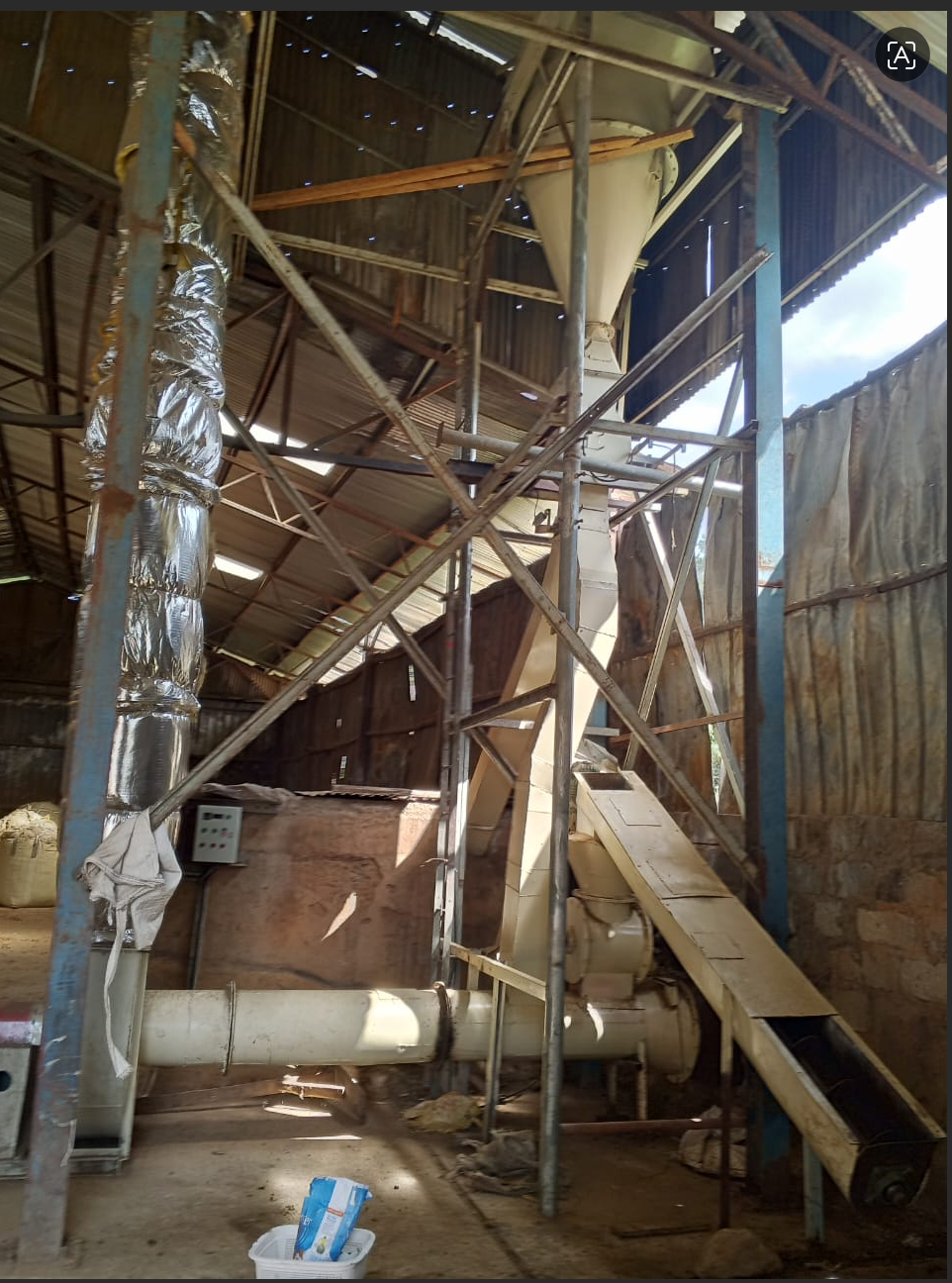
Africa’s first mechanized EcoDryer transforms wet sugarcane bagasse into high-quality biomass fuel for briquette production, enabling year-round operation while reducing drying costs and converting agricultural waste into clean energy.
Date:
Location:
Kenya
Partners:
University of Huddersfield, Kibabii University, Carbon Footprint Ltd and UK Research and Innovation (UKRI)
Research Area:
Decarbonizing Industry & Circular Economy
Sustainable Development Goals:
07 - Affordable and Clean Energy, 09 - Industry, Innovation and Infrastructure, 12 - Responsible Consumption and Production, 13 - Climate Action
Transforming Sugarcane Waste into Sustainable Energy
The EcoDryer, developed through the African Agriculture Knowledge Transfer Partnership (AAKTP), addresses the underutilization of sugarcane bagasse in sub-Saharan Africa. Sugar factories generate large quantities of bagasse, much of which is dumped, openly burned, or left to decompose because conventional drying methods depend on sunshine and manual labour. The EcoDryer provides a mechanized, weather-independent solution that transforms wet bagasse into high-quality biomass fuel for briquette production.
The innovation replaces slow and labour-intensive sun drying with continuous mechanized drying, enabling significantly higher productivity and consistent moisture content suitable for briquetting throughout the year. The system has increased drying capacity from approximately 5 tonnes to 40 tonnes per day while reducing drying costs by more than 40%. The dried bagasse is subsequently converted into binder-free biomass briquettes with high calorific value, providing a renewable alternative to charcoal and firewood for households, schools, and institutions.
Proven Performance and Circular Economy Impact
The EcoDryer has reached the market-ready/commercialized stage, having completed prototype development, pilot testing, process optimization, and commercial validation under real operating conditions. The technology has demonstrated consistent product quality, reduced labour requirements, weather-independent operation, and commercial feasibility. Intellectual property protection has also been secured through a Kenya Industrial Property Institute (KIPI) utility model, supporting further commercialization.
By converting agricultural waste into renewable fuel, the solution reduces waste, greenhouse gas emissions, and reliance on charcoal and firewood, while helping reduce pressure on forests and indoor air pollution. It also creates opportunities for rural industrialization, green enterprises, employment, and additional value generation within agricultural supply chains.
Scaling Across Africa
The EcoDryer has a modular design that allows it to be adapted to different agricultural residues, including rice husks, maize stalks, and other biomass resources. Its proven increase in drying capacity from 5 to 40 tonnes per day provides a strong basis for deployment in sugar-producing regions and other agricultural industries across Africa.
The project is supported by partnerships between Kibabii University, the University of Huddersfield, Carbon Footprint Limited, and UK Research and Innovation (UKRI). The team is seeking investment, sugar-industry partners, technology licensing and commercialization support, and policy partnerships to manufacture and deploy the EcoDryer at larger scale and replicate the technology across Africa’s emerging circular bioeconomy.