Africa generates millions of tonnes of underutilised agricultural biomass each year, while micronutrient deficiencies continue to affect millions of children. This project transforms agricultural residues such as cassava peels, banana residues, maize residues, cocoa pod husks and coffee by-products into affordable, nutrient-rich ingredients for child nutrition products.
Date:
-
Location:
Selected African Countries
Partners:
-
Research Area:
Decarbonizing Industry & Circular Economy
Sustainable Development Goals:
02 - Zero Hunger, 03 - Good Health and Well-Being, 08 - Decent Work and Economic Growth, 09 - Industry, Innovation and Infrastructure, 12 - Responsible Consumption and Production
Africa produces substantial quantities of underutilised agricultural biomass, including cassava peels, banana residues, maize residues, cocoa pod husks and coffee by-products. At the same time, micronutrient deficiencies and child malnutrition remain major challenges in many African communities. This project addresses both issues simultaneously by developing safe, nutrient-rich ingredients from agricultural residues and transforming them into affordable, child-friendly nutrition products. Led by SIRIM Berhad, the programme combines nutrient recovery, food-compatible processing, safety validation and technology transfer to create a pathway from agricultural waste to commercially viable nutrition solutions.
Challenge
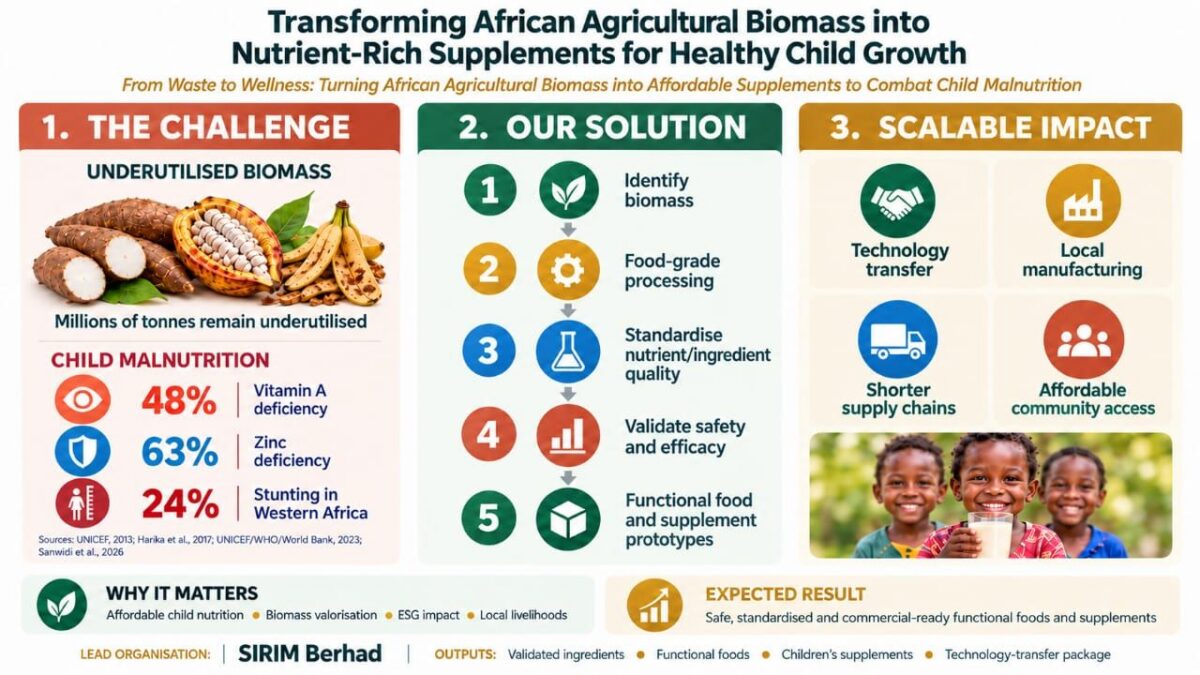
Large volumes of agricultural residues remain underutilised despite containing valuable nutrients and bioactive compounds. At the same time, children in many African countries face significant deficiencies in essential micronutrients. The project highlights reported deficiencies affecting vitamin A and zinc, alongside high levels of childhood stunting in Western Africa. Converting locally available biomass into validated nutritional ingredients therefore offers an opportunity to address agricultural waste and nutritional vulnerability within a single circular-economy approach.
Solution and Innovation
The programme will identify and characterise suitable agricultural biomass according to nutritional value, availability, sustainability and safety. Key nutrients—including iron, zinc, calcium, vitamin A or provitamin A, B vitamins and protein—will be assessed alongside beneficial plant compounds and dietary fibre.
Food-compatible processing and extraction technologies will then be used to recover and concentrate valuable nutrients while preserving nutritional quality. The resulting ingredients will be standardised and subjected to quality, safety, nutrient-retention and bioaccessibility testing. Validated ingredients will be incorporated into affordable, child-friendly products, including nutrient-dense complementary foods, cereal and dairy-based foods, fortified food powders and nutrient sachets. Product development will consider taste, texture, stability, affordability and local acceptance.
The innovation pathway is:
African Agricultural Biomass → Nutrient Recovery → Standardised Ingredients → Safety & Nutritional Validation → Child Nutrition Products → Pilot Scale-Up → Prototypes Ready for Commercialisation
Expected Impact
The project creates value from agricultural by-products while contributing to improved child nutrition and healthy growth. Locally sourced biomass can become a source of affordable nutrition ingredients, reducing agricultural waste and supporting circular production models. The approach can also generate new economic opportunities and livelihoods while helping food and nutrition businesses address ESG requirements.
Standardised ingredients and locally adapted products are intended to improve access to affordable nutritional solutions in communities that are particularly vulnerable to malnutrition. Nutrient profiling, efficacy and safety testing, together with claim substantiation, will provide the evidence base needed for subsequent commercialisation.
Development and Scale-Up
The project is currently at the Prototype in Development stage. SIRIM has already developed proven know-how for standardising the conversion of agricultural biomass into nutrient-rich ingredients suitable for food supplements. This established process will be replicated and scaled within the project to deliver reliable and consistent outputs.
Pilot-scale production will demonstrate the feasibility of the approach and support the development of commercial-ready functional foods and children’s supplements. Technology transfer to qualified local entrepreneurs in selected African countries will provide a pathway towards regional production and commercialisation. The use of locally available biomass, regional manufacturing and shorter supply chains could reduce production and distribution costs, subject to techno-economic validation.
The project is seeking partnerships with African entrepreneur associations and health-provider organisations, alongside WAITRO funding to support the commercialisation process, technology transfer and expansion into selected African markets.