
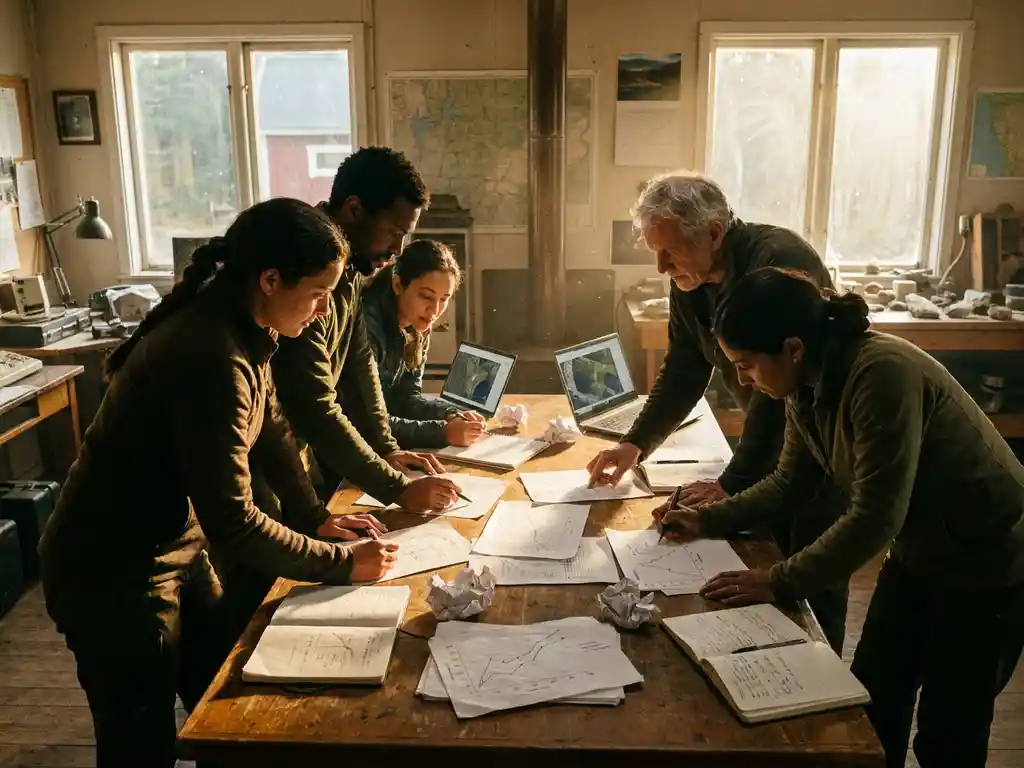
Social innovation in climate research is an approach that integrates social science methods, community engagement, and collaborative problem-solving to develop climate solutions that address both environmental and social challenges. It emphasizes participatory research methods, stakeholder involvement, and the co-creation of knowledge to ensure that climate research translates into actionable, equitable solutions that communities can adopt and sustain.
Traditional research silos are limiting your climate impact
When climate research operates in isolation from social realities, it can produce technically sound solutions that fail to gain community adoption or address underlying social barriers to implementation. This disconnect means your research may solve the scientific problem but miss the human factors that determine whether solutions actually work in practice. The result is wasted resources, delayed climate action, and missed opportunities to create lasting change. To bridge this gap, integrate social science perspectives from the project’s inception, involve affected communities as research partners rather than subjects, and design studies that account for social, economic, and cultural factors alongside technical feasibility.
Researcher-centered approaches are missing critical stakeholder insights
Climate research that prioritizes academic perspectives over community knowledge can create solutions that are scientifically valid but practically ineffective or culturally inappropriate. This top-down approach overlooks local expertise, traditional knowledge systems, and the real-world constraints that shape how communities respond to climate challenges. The consequence is research that fails to address actual needs and solutions that communities cannot or will not implement. Shift toward participatory research methods in which communities help define research questions, contribute their knowledge, and shape the development of solutions from the beginning.
What is social innovation in climate research?
Social innovation in climate research is a methodology that combines scientific investigation with social engagement to develop climate solutions through collaborative, participatory processes. It integrates diverse knowledge systems, involves affected communities as active partners, and focuses on creating actionable solutions that address both the environmental and social dimensions of climate challenges.
This approach recognizes that climate change is fundamentally a social problem that requires social solutions. Rather than treating communities as passive recipients of research findings, social innovation positions them as co-creators of knowledge and solutions. The methodology draws from fields such as participatory action research, community-based research, and transdisciplinary studies to ensure research outcomes are relevant, implementable, and sustainable.
Key characteristics include stakeholder engagement throughout the research process, the integration of scientific and local knowledge, a focus on equity and justice, and an emphasis on building capacity within communities to continue innovating beyond the initial research project.
How does social innovation differ from traditional climate research?
Social innovation differs from traditional climate research by prioritizing collaboration, community engagement, and social outcomes alongside scientific rigor. While traditional research often follows a linear path from hypothesis to publication, social innovation employs iterative, participatory methods that involve stakeholders as partners in defining problems, conducting research, and developing solutions.
Traditional climate research typically focuses on understanding physical and biological systems, generating knowledge that experts then translate for public consumption. The research process is usually controlled by academic institutions, with limited input from affected communities until the dissemination phase. Success is measured primarily through publications, citations, and scientific advancement.
Social innovation takes a more holistic approach that considers social, economic, and cultural factors as integral to climate solutions. Research questions emerge from dialogue between researchers and communities, methods are adapted to local contexts, and success includes measures of community capacity building, solution adoption, and social impact. The process is inherently collaborative, with knowledge flowing in multiple directions among researchers, practitioners, and community members.
What are the main approaches to social innovation in climate research?
The main approaches to social innovation in climate research include participatory action research, community-based participatory research, transdisciplinary research, design thinking methodologies, and living lab approaches. Each method emphasizes different aspects of collaboration and knowledge integration while maintaining a focus on actionable climate solutions.
Participatory action research involves communities in identifying research priorities, collecting data, and implementing solutions. This approach ensures research addresses real community needs while building local capacity for ongoing innovation. Community-based participatory research follows similar principles but emphasizes academic-community partnerships with shared control over the research process.
Transdisciplinary research brings together experts from multiple disciplines and community stakeholders to tackle complex climate challenges that require diverse perspectives. Design thinking applies human-centered design principles to climate problems, using empathy, ideation, and prototyping to develop user-focused solutions.
Living labs create real-world testing environments in which researchers, communities, and other stakeholders can experiment with climate solutions in authentic settings. These approaches often combine multiple methods, adapting their strategies based on local contexts and research objectives.
How do research organizations implement social innovation for climate solutions?
Research organizations implement social innovation for climate solutions by establishing community partnerships, training researchers in participatory methods, creating interdisciplinary teams, and developing flexible funding and evaluation frameworks that support collaborative research processes and long-term community engagement.
Implementation begins with relationship building and trust development between researchers and community partners. Organizations must invest time in understanding local contexts, identifying key stakeholders, and establishing shared goals and expectations. This foundation enables meaningful collaboration throughout the research process.
Successful implementation requires organizational changes, including training researchers in facilitation and community engagement skills, adjusting project timelines to accommodate participatory processes, and adopting evaluation criteria that value community outcomes alongside traditional academic metrics. Organizations often create dedicated roles for community liaisons or participatory research coordinators.
Funding structures must support longer project timelines, community compensation, and capacity-building activities. Organizations may need to diversify funding sources, combining academic grants with community development funds, corporate partnerships, or government programs focused on social innovation.
What role do global research networks play in climate social innovation?
Global research networks play a crucial role in climate social innovation by facilitating knowledge sharing, enabling cross-cultural learning, scaling successful solutions, and providing platforms for international collaboration that amplify local innovations and address climate challenges that transcend national boundaries.
These networks connect researchers and communities working on similar challenges across different regions, enabling them to share methodologies, adapt solutions to local contexts, and learn from diverse approaches to common problems. This cross-pollination accelerates innovation and prevents duplication of effort.
Global networks also provide resources and expertise that individual organizations or communities might lack. They can facilitate access to funding, technical support, training opportunities, and policy advocacy platforms. Networks help smaller organizations and communities participate in international climate discussions and influence global climate policy.
Through coordinated research initiatives, global networks can tackle climate challenges that require large-scale, multi-site studies. They enable comparative research across different contexts, helping identify which social innovation approaches work best under various conditions and how solutions can be adapted to different cultural and economic settings.
How can social innovation in climate research contribute to the SDGs?
Social innovation in climate research contributes to the Sustainable Development Goals by addressing multiple SDGs simultaneously through integrated solutions that advance climate action alongside poverty reduction, health improvement, education access, and social equity. This approach recognizes the interconnected nature of global challenges and develops solutions that create co-benefits across multiple development areas.
Climate social innovation directly supports SDG 13 (Climate Action) while contributing to other goals through its participatory and equity-focused approach. For example, community-based renewable energy projects address climate change while advancing SDG 7 (Affordable and Clean Energy) and SDG 1 (No Poverty) by creating local economic opportunities.
The participatory nature of social innovation supports SDG 16 (Peace, Justice and Strong Institutions) by promoting inclusive decision-making and community empowerment. Gender-inclusive research methods advance SDG 5 (Gender Equality), while a focus on vulnerable populations contributes to SDG 10 (Reduced Inequalities).
By integrating local knowledge with scientific research, social innovation supports SDG 4 (Quality Education) through capacity building and knowledge exchange. The emphasis on sustainable, community-appropriate solutions contributes to SDG 11 (Sustainable Cities and Communities) and SDG 15 (Life on Land) by promoting environmentally sound development practices.
How WAITRO Helps with Climate Social Innovation
As the world’s largest network of research and technology organizations, we facilitate climate social innovation by connecting researchers, communities, and institutions across 135 full member organizations worldwide. Our platform enables the collaborative, cross-border partnerships essential for effective climate social innovation while supporting knowledge sharing and capacity building that amplify local solutions globally.
We support climate social innovation through several key initiatives:
- Global networking: Connecting research organizations with community partners and facilitating international collaborations that bring diverse perspectives to climate challenges
- Capacity building programs: Providing training and resources that help member organizations develop participatory research capabilities and community engagement skills
- Knowledge sharing platforms: Enabling researchers to share methodologies, case studies, and lessons learned from social innovation projects across different cultural and geographic contexts
- SDG alignment: Supporting research initiatives that address multiple Sustainable Development Goals through integrated climate and social solutions
- Innovation ecosystem support: Facilitating partnerships between research institutions, communities, and industry partners to scale successful social innovations
The WAITRO Summit 2026 in Istanbul, Türkiye (October 26-28, 2026) will focus on “Leading the Path of Implementation: Strengthening Co-Creation for Our Common Future.” This gathering provides an ideal opportunity to connect with global innovators working on climate social innovation, share your research experiences, and participate in co-creation sessions that shape the future of collaborative climate research. Join us to be part of a movement that transforms how we approach climate challenges through social innovation.
Ready to expand your climate research impact through global collaboration? Become a member to access our network of research organizations and start building the partnerships that will amplify your social innovation efforts.
