
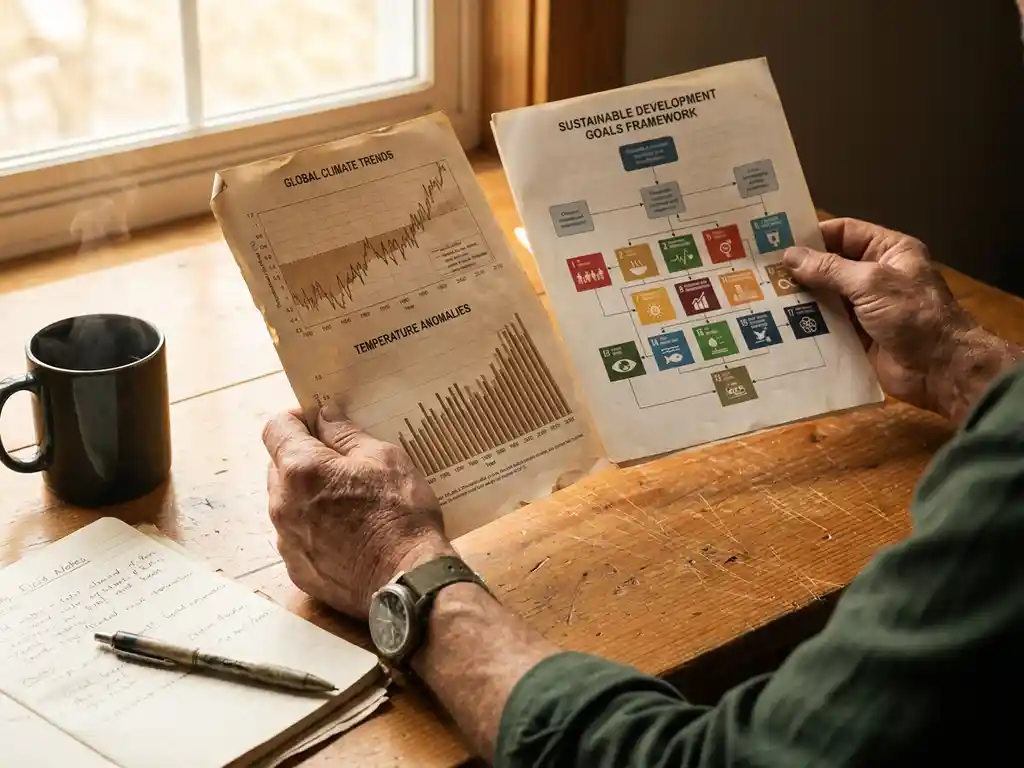
The SDGs and the Paris Agreement are deeply interconnected frameworks that reinforce each other in the pursuit of a sustainable, equitable future. The Sustainable Development Goals (SDGs) provide a broad blueprint for human and planetary well-being across 17 goals, while the Paris Agreement focuses specifically on limiting global temperature rise and building climate resilience. Together, they form two pillars of the same global commitment: ensuring that development today does not compromise the planet tomorrow. The sections below unpack how these frameworks relate, where they differ, and why both matter for research and technology organizations working at the frontier of innovation.
How do the SDGs and the Paris Agreement reinforce each other?
The SDGs and the Paris Agreement reinforce each other because climate stability is a prerequisite for sustainable development, and sustainable development creates the conditions needed to meet climate targets. Progress on one framework directly supports progress on the other, making them mutually dependent rather than parallel or competing agendas.
At the most fundamental level, the Paris Agreement’s goal of limiting warming to 1.5°C above pre-industrial levels protects the very foundations that the SDGs depend on: stable food systems, reliable water supplies, healthy ecosystems, and resilient communities. Without climate action, gains in poverty reduction, health, and economic development are routinely undone by extreme weather events, sea-level rise, and ecosystem degradation.
In the other direction, the SDGs create the social and institutional infrastructure that makes climate commitments achievable. Reducing poverty (SDG 1), improving education (SDG 4), and building strong institutions (SDG 16) all contribute to societies that are better equipped to transition to low-carbon economies and adapt to climate impacts. A country investing in clean energy access (SDG 7) is simultaneously reducing emissions in line with Paris Agreement obligations.
This mutual reinforcement is why the United Nations consistently frames the two frameworks as complementary rather than separate. Nationally Determined Contributions (NDCs) under the Paris Agreement increasingly reference SDG targets, and SDG implementation plans frequently incorporate climate metrics. The relationship is not accidental but by design.
Together, We Drive Innovation
Support global research, foster collaboration, and create a sustainable future.
What are the key differences between the SDGs and the Paris Agreement?
The key difference between the SDGs and the Paris Agreement lies in their scope and legal nature. The SDGs are a voluntary, universal agenda covering 17 goals and 169 targets across economic, social, and environmental dimensions. The Paris Agreement is a legally binding international treaty with a specific focus on climate change, particularly greenhouse gas emissions and temperature limits.
Several other distinctions are worth understanding:
- Scope: The SDGs address the full spectrum of sustainable development, from gender equality to ocean health to urban planning. The Paris Agreement addresses climate change specifically, including mitigation, adaptation, and climate finance.
- Legal status: The Paris Agreement is a binding treaty under international law, ratified by nearly every country. The SDGs are a political commitment without enforcement mechanisms.
- Timeline: The SDGs were set with a 2030 deadline. The Paris Agreement sets long-term temperature goals with no fixed end date, though NDCs are reviewed every five years.
- Governance: The Paris Agreement is governed under the UN Framework Convention on Climate Change (UNFCCC). The SDGs are overseen through the UN General Assembly and the High-Level Political Forum.
- Measurement: The SDGs have a detailed global indicator framework. Paris Agreement progress is measured through each country’s own NDC reporting, making comparisons more complex.
Understanding these differences matters for organizations designing programs or policies, because the two frameworks require different accountability structures and different types of action, even when they point toward the same outcomes.
Which SDGs are most directly linked to the Paris Agreement?
SDG 13 (Climate Action) is the most direct link to the Paris Agreement, as it explicitly calls for urgent action to combat climate change and its impacts, mirroring the core mandate of the Paris Agreement. However, several other SDGs are deeply connected to climate commitments and Paris Agreement implementation.
- SDG 7 (Affordable and Clean Energy): Transitioning to renewable energy is central to reducing emissions under the Paris Agreement. Expanding clean energy access directly supports NDC targets.
- SDG 11 (Sustainable Cities and Communities): Urban areas are major sources of emissions and key sites for climate adaptation. Sustainable urban planning contributes to both frameworks simultaneously.
- SDG 14 (Life Below Water) and SDG 15 (Life on Land): Ocean and forest ecosystems are critical carbon sinks. Protecting them supports both biodiversity goals and climate mitigation.
- SDG 2 (Zero Hunger): Agriculture is both vulnerable to climate change and a significant source of emissions. Sustainable food systems are addressed in both frameworks.
- SDG 9 (Industry, Innovation and Infrastructure): Low-carbon industrial transformation and resilient infrastructure are central to long-term climate and development goals.
In practice, most SDGs have some climate dimension, either because climate change threatens progress toward them or because achieving them requires emissions reductions. The overlap is extensive, which is why integrated policy approaches consistently outperform siloed ones.
Can a country meet its Paris Agreement targets without achieving the SDGs?
Technically, a country could meet its Paris Agreement targets without fully achieving the SDGs, but in practice the two are deeply interdependent. Narrow emissions reductions achieved through policies that increase inequality, undermine food security, or damage ecosystems would likely be unsustainable and politically fragile over time.
There are real-world scenarios where this tension appears. A country might reduce emissions by restricting industrial activity in ways that increase unemployment, or by expanding hydropower in ways that displace communities. These approaches may deliver short-term climate metrics while setting back SDG progress on poverty, inequality, or ecosystem health.
The more durable path, and the one advocated by the UN and most development institutions, is to pursue climate action that is also just, inclusive, and development-positive. This means designing transitions that create decent work (SDG 8), protect vulnerable populations (SDG 1 and SDG 10), and preserve natural systems (SDG 14 and SDG 15).
The concept of a “just transition” captures this logic: the shift to a low-carbon economy must be managed in ways that leave no one behind. Countries that integrate SDG thinking into their Paris Agreement strategies are more likely to build the broad social coalitions needed for long-term climate policy to hold.
How do research and technology organizations support both frameworks?
Research and technology organizations (RTOs) support both the SDGs and the Paris Agreement by developing and deploying the technologies, knowledge, and institutional capacities that make both frameworks achievable. RTOs sit at the intersection of science and application, translating research into real-world solutions for industries, governments, and communities.
In practical terms, RTOs contribute across multiple dimensions:
- Clean technology development: RTOs advance renewable energy systems, energy efficiency solutions, and low-carbon industrial processes that directly reduce emissions in line with Paris Agreement targets.
- Climate adaptation research: RTOs develop tools and strategies for climate resilience, from drought-resistant crops to flood-resistant infrastructure, supporting SDG progress in vulnerable regions.
- Policy and technical advisory roles: RTOs provide governments with the evidence base needed to design credible NDCs and SDG implementation plans grounded in scientific and technological realities.
- Knowledge transfer and capacity building: RTOs help lower-income countries access and adapt technologies developed elsewhere, addressing the technology transfer commitments embedded in both frameworks.
- Cross-sector collaboration: RTOs bridge academia, industry, and government, enabling the multi-stakeholder partnerships (SDG 17) that both climate and sustainable development goals require.
The role of RTOs is not peripheral but central. Neither the Paris Agreement nor the SDGs can be achieved through political commitments alone. Both require sustained investment in research, innovation, and the organizations that connect knowledge to action.
How WAITRO supports RTOs working on climate and sustainable development
At WAITRO, we support research and technology organizations in building the capabilities and partnerships they need to contribute meaningfully to both the SDGs and the Paris Agreement. Our work is designed for RTOs that want to increase their impact at the intersection of climate action and sustainable development.
Here is how we help:
- Global network access: We connect our 135 Full Members and 45 Associate Members with world-leading research organizations, opening pathways for collaborative projects on climate, clean energy, and sustainable development.
- Capacity development: Our Capacity Development Program strengthens institutional skills in areas including sustainability and digital transformation, helping RTOs deliver higher-impact solutions aligned with both frameworks.
- Strategic partnerships: We facilitate cross-border collaboration with organizations like Fraunhofer and Leitat, giving members access to expertise and resources that amplify their contribution to climate and SDG goals.
- Knowledge sharing platforms: We provide forums and initiatives where members can exchange insights, co-develop solutions, and align their work with global sustainability frameworks.
If your organization is working to advance climate action or sustainable development and wants to do so with a stronger global network behind it, we invite you to explore WAITRO membership and connect with a community built for exactly this purpose.
