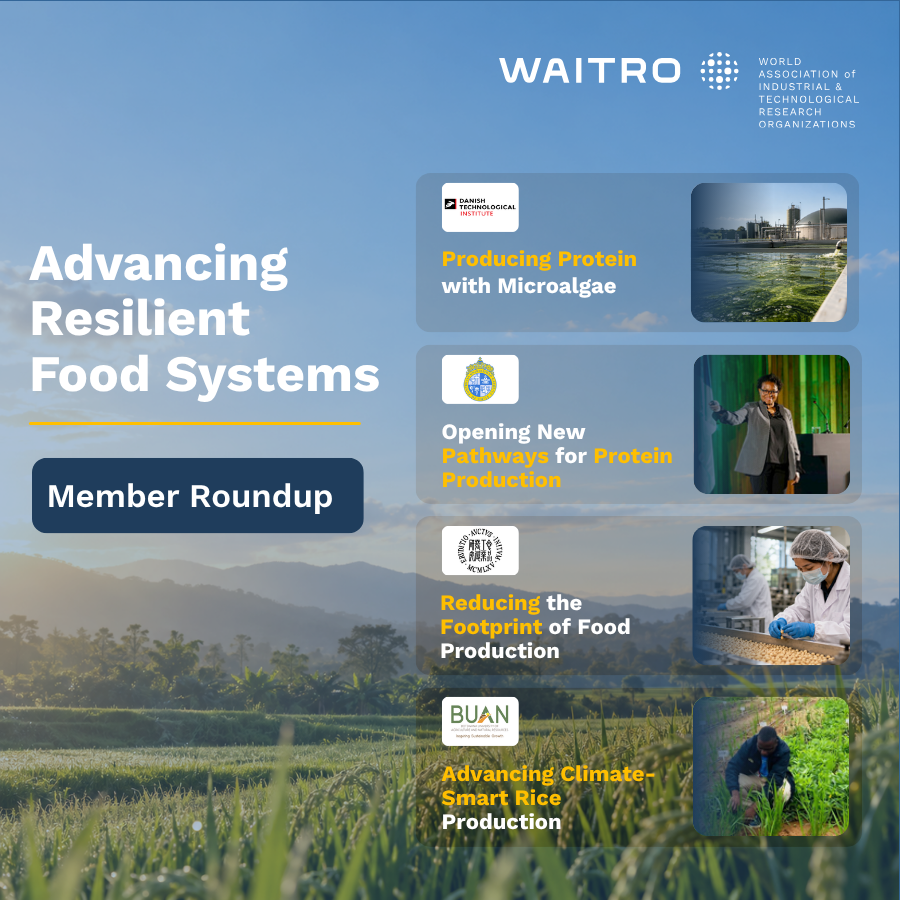
From microalgae-based protein and new fermentation technologies to low-carbon food processing and climate-smart agriculture, WAITRO members are exploring different pathways towards food systems that use resources more efficiently and are better equipped for changing environmental conditions.
Food systems face a complex challenge: meeting growing demand while dealing with pressures on land, water and other natural resources, reducing environmental impacts and adapting agricultural production to a changing climate. Addressing these interconnected challenges requires innovation across the entire food system, from how food is produced to how it is processed and supplied.
Across the WAITRO Global Innovation Family, research and technology organizations are approaching this transformation from different perspectives. This month’s Member Roundup brings together four initiatives from Denmark, Chile, Taiwan and Botswana that demonstrate how research, technology and international collaboration can contribute to more sustainable and resilient food systems.
Producing Protein with Microalgae
The Danish Technological Institute (DTI) is leading the SUMIT project, which explores a circular approach to alternative protein production. At its core is the cultivation of microalgae, which can provide high protein yields without requiring conventional agricultural land.
SUMIT integrates microalgae cultivation with CO₂ capture and nutrient recovery from biogas plants. Instead of treating these resource streams separately, the project brings them together in an integrated production model: CO₂ and recovered nutrients from biogas production become inputs for growing microalgae.
DTI coordinates the project and is developing climate-adapted, high-productivity microalgae strains while supporting the transition from laboratory research to pilot-scale application. By combining these technologies, SUMIT aims to demonstrate how protein can be produced efficiently while requiring less agricultural land and water than conventional protein sources.
Opening New Pathways for Protein Production
What if protein production did not depend on conventional agriculture at all?
At the International Seminar on Food for the Future, organized by the Copec-UC Foundation, Pontificia Universidad Católica de Chile highlighted Air Protein, an approach originating from research into how food could be produced in resource-constrained environments.
Air Protein uses a process known as elemental fermentation. Microorganisms are combined with elements from air and water and renewable energy to produce a nutrient-rich protein, which is then processed into flour. According to the initiative, the resulting ingredient contains more than 80% protein and all essential amino acids and can be used in products ranging from pasta and baked goods to cereals and creams.
Because production is not dependent on arable land and can operate in controlled environments, the approach points towards new possibilities for producing protein with significantly lower resource requirements.
Reducing the Footprint of Food Production
Transforming food systems also means looking beyond primary production to the technologies used to process food and move it through supply chains.
In March 2026, the Food Industry Research and Development Institute (FIRDI) from Taiwan hosted an APEC workshop in Taipei dedicated to innovative food processing technologies for low-carbon food supply chains. The event brought together representatives from eleven APEC economies as well as research institutions, government agencies and industry experts.
The workshop showcased different technological pathways towards reducing the environmental footprint of food production. These included smart low-carbon processing systems, circular approaches that turn food industry by-products into new resources and alternative food ingredients and proteins. Practical examples ranged from heat recovery and energy-efficient production processes to the upcycling of wheat bran and the development of alternative proteins from fungi and plant sources.
By bringing together technological expertise and experiences from across the Asia-Pacific, the workshop also demonstrated the role international knowledge exchange can play in accelerating the transition towards more sustainable food supply chains.
Advancing Climate-Smart Rice Production
In Botswana, the challenge looks different. Semi-arid conditions, limited soil fertility and climate variability create particular pressures for agricultural production.
Researchers at the Botswana University of Agriculture and Natural Resources (BUAN) are exploring climate-smart approaches to rice production by intercropping upland rice with legumes such as cowpea and Bambara groundnut. The research investigates how combining these crops can improve soil fertility and productivity while reducing dependence on synthetic fertilizers.
The approach takes advantage of the ability of legumes to contribute nitrogen to agricultural systems while simultaneously diversifying production. By examining how these interactions perform under Botswana’s environmental conditions, the research aims to generate knowledge for farming systems that are both productive and better adapted to climate-related pressures.
Different Pathways, One Shared Challenge
From producing protein with microalgae and fermentation to lowering emissions in food processing and adapting agriculture to semi-arid conditions, these initiatives address very different parts of the food system. What connects them is the search for ways to produce food while making more effective use of available resources and strengthening resilience.
They also demonstrate the diversity of expertise within the WAITRO Global Innovation Family. By connecting research and technology organizations across regions and disciplines, WAITRO creates opportunities for knowledge, technologies and perspectives developed in different contexts to come together around shared global challenges.
Interested in Sharing Your Story?
We’re always looking to highlight inspiring research, innovation and collaboration from across the WAITRO Global Innovation Family.
Share your success story with us and we’ll feature it on our website and social media channels to help amplify your impact, inspire others and connect your work with a global audience. More information on https://waitro.org/share-projects-news-events/.
Author