Turning fats, oils, and grease recovered from meat and dairy wastewater into biodiesel, reducing industrial pollution while recovering valuable resources for renewable energy production.
Date:
-
Location:
Uganda
Partners:
-
Research Area:
Climate Resilience & the Water–Food–Energy Nexus
Sustainable Development Goals:
06 - Clean Water and Sanitation, 07 - Affordable and Clean Energy, 09 - Industry, Innovation and Infrastructure, 12 - Responsible Consumption and Production, 13 - Climate Action
Turning Fatty Wastewater into Biodiesel
The Uganda Industrial Research Institute (UIRI) has developed a circular solution that transforms fats, oils, and grease (FOG) from meat and dairy processing wastewater into renewable biodiesel. These industries generate wastewater containing significant amounts of FOG, which can clog drainage systems, disrupt wastewater treatment, and pollute water when poorly managed. At the same time, many small and medium-sized agro-industries lack affordable technologies to recover these materials and often discard fats that could serve as valuable renewable fuel feedstock.
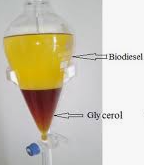
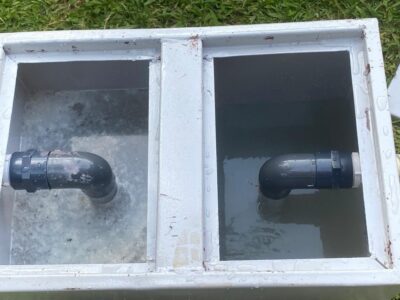
The solution uses a locally fabricated, two-stage gravity-based FOG trap to separate and concentrate fats, oils, and grease from wastewater before it enters downstream treatment. The recovered FOG is subsequently converted into biodiesel, creating a simple circular pathway: fatty wastewater → FOG recovery → biodiesel → renewable energy. The process also incorporates a catalyst derived from calcined fish scales, demonstrating how multiple waste streams can be converted into useful resources.
High-Efficiency Waste Recovery and Renewable Fuel
Testing has demonstrated strong technical potential. The FOG interceptor achieved approximately 98.5% FOG removal, substantially reducing the amount of grease entering downstream wastewater treatment. The recovered FOG was successfully converted into biodiesel, achieving yields between 81.62% and 86.83%, with an average yield of approximately 84.52% under the tested conditions.
These results demonstrate the feasibility of converting a problematic wastewater pollutant into a renewable energy feedstock. The approach can help agro-industries reduce water pollution, improve wastewater management, recover economic value from waste, and reduce dependence on fossil fuels. Its modular design and use of locally available materials also make it particularly suitable for resource-constrained processing facilities.
Pilot Demonstration and Scale-Up
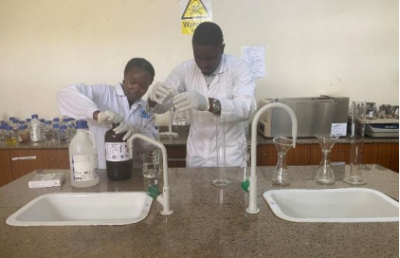
The innovation is currently at the proof-of-concept stage, with feasibility demonstrated under controlled laboratory conditions. The next development phase will focus on demonstrating the complete system at UIRI and selected meat and dairy processing facilities, optimizing biodiesel production, and conducting comprehensive fuel-quality testing.
The technology can subsequently be scaled by adapting the FOG recovery system to larger wastewater volumes and developing partnerships with agro-industrial companies, investors, and technology providers. UIRI is seeking funding for system scale-up and pilot implementation, technical support for process optimization, and policy support to promote waste-to-energy solutions. The model has potential for wider deployment across Uganda and replication in other countries with meat and dairy processing industries.