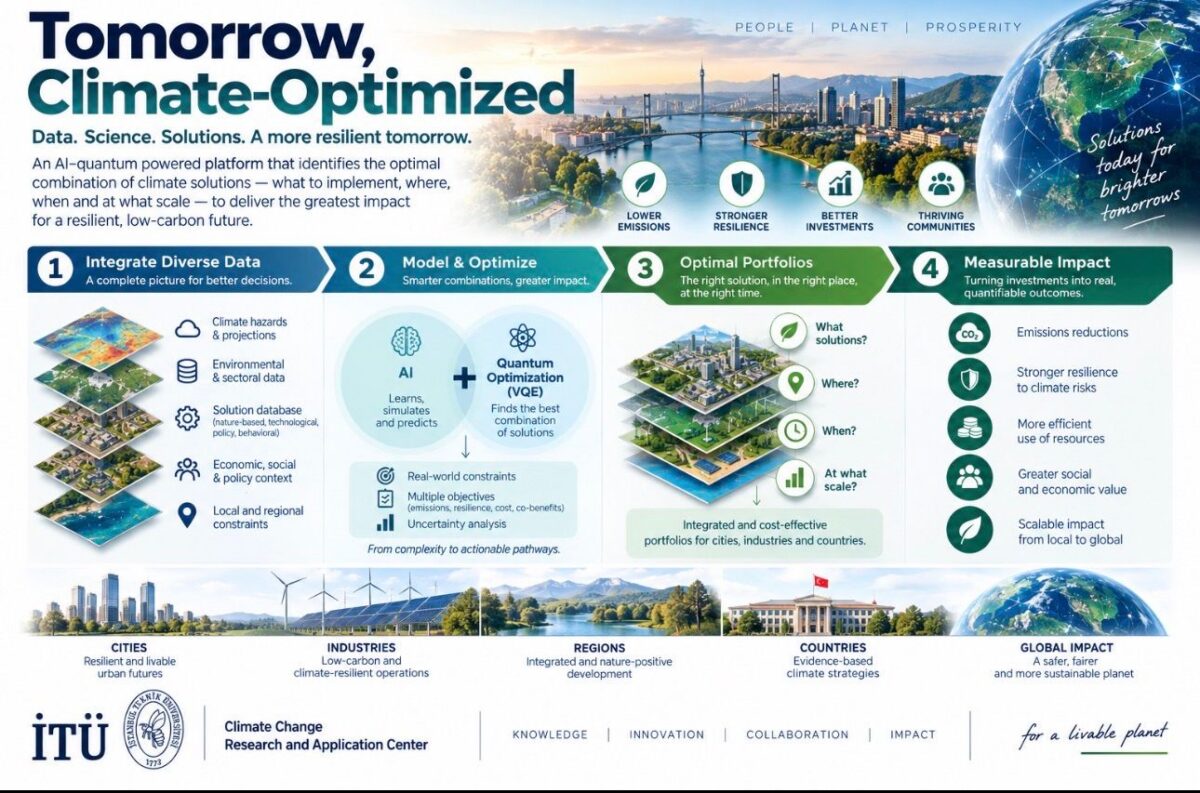
Tomorrow, Climate-Optimized is an emerging decision-support innovation that combines climate science, artificial intelligence, advanced optimization and quantum computing to identify combinations of climate actions capable of delivering the greatest measurable impact under real-world resource constraints.
Date:
-
Location:
Turkey
Partners:
-
Research Area:
Climate Resilience & the Water–Food–Energy Nexus
Sustainable Development Goals:
07 - Affordable and Clean Energy, 09 - Industry, Innovation and Infrastructure, 11 - Sustainable Cities an Communities, 12 - Responsible Consumption and Production, 13 - Climate Action
Challenge
Governments, cities, industries and communities can choose from a rapidly expanding range of climate interventions, including renewable energy, energy efficiency, sustainable mobility, water conservation, circular-economy measures, nature-based solutions and climate-resilient infrastructure. The challenge is increasingly not a lack of potential solutions, but determining what to implement, where, when, at what scale and in which combination.
Conventional decision-making can struggle with the complexity of these choices, particularly when interventions interact with one another or create trade-offs across emissions, resilience, resource efficiency, economic value and implementation feasibility. The project therefore seeks to turn climate-resource allocation into a systematic optimization problem.
Solution and Innovation
Tomorrow, Climate-Optimized will combine climate science, artificial intelligence, advanced optimization and quantum computing to explore multiple climate-action pathways simultaneously. AI will learn from climate, environmental, socioeconomic and implementation data, while optimization methods will search across potential intervention portfolios.
A key innovation is the exploration of hybrid quantum-classical optimization, in which emerging quantum methods work alongside conventional computing to address complex resource-allocation problems involving very large numbers of possible choices. The decision framework is intended to consider greenhouse-gas reduction, climate resilience, water and energy efficiency, circular resource use, economic value and implementation feasibility. Where robust evidence is available, avoided climate damages, social benefits and longer-term climate outcomes can also be incorporated.
For example, a city with a fixed climate budget could compare portfolios combining renewable energy, building retrofits, water reuse, sustainable transport, nature-based solutions and circular-economy interventions. Instead of receiving separate recommendations for each measure, decision-makers would receive optimized pathways showing how available resources could generate the greatest measurable climate impact while making trade-offs transparent.
Expected Impact
The platform aims to help decision-makers avoid inefficient allocation of scarce resources and accelerate evidence-based climate action. By identifying interventions that work particularly well together, it could increase emissions reductions, strengthen climate resilience, improve water and energy efficiency and increase the value generated by climate investments.
The framework is also designed to address the Water–Food–Energy Nexus, helping identify solutions that generate benefits across interconnected systems rather than improving one sector at the expense of another. Its proposed continuous cycle—solutions → optimized choices → implementation → measurable impact → scaling—would allow real-world outcomes to feed back into the platform and strengthen future decision-making.
Development and Scale-Up
The project is currently at the Concept / Idea stage, with no prototype yet. The planned development pathway is to progress toward prototype development and subsequently conduct real-world pilots with cities and industries. Pilot results will be used to validate optimized pathways against measurable outcomes and refine the platform using implementation data.
Following successful pilots, the approach could be replicated across regions and countries through standardized modules and international partnerships. The framework is intended to scale from individual institutions and municipalities to regions, countries and international climate programmes.
The project is seeking technology and research partners to co-develop the platform, as well as cities, industries and governments able to provide data and host pilots. Climate-finance and policy partners are also sought to validate impact, mobilize investment and support international scaling.
Screenshot