An affordable household water filtration and WASH education solution designed to improve access to safe drinking water and reduce diarrhea and malnutrition among children in flood-affected communities.
Date:
-
Location:
District Jamshoro, Sindh, Pakistan
Partners:
The Pakistan Council of Research in Water Resources; Grand Challenges Canada
Research Area:
Climate Resilience & the Water–Food–Energy Nexus
Sustainable Development Goals:
02 - Zero Hunger, 03 - Good Health and Well-Being, 06 - Clean Water and Sanitation, 10 - Reduced Inequalities, 13 - Climate Action
Affordable Household Water Filtration for Flood-Affected Communities
The Aga Khan University has developed and tested an affordable point-of-use water filtration solution combined with practical water, sanitation, and hygiene (WASH) education to reduce diarrheal disease and malnutrition among children under five in flood-affected communities in Sindh, Pakistan. The initiative addresses severe water contamination following floods, when damaged infrastructure forces families to rely on unsafe water sources. The intervention was implemented near Manchar Lake in District Jamshoro and was designed to assess not only water quality improvements but also whether households could consistently use, maintain, and accept the filters under real-world conditions.
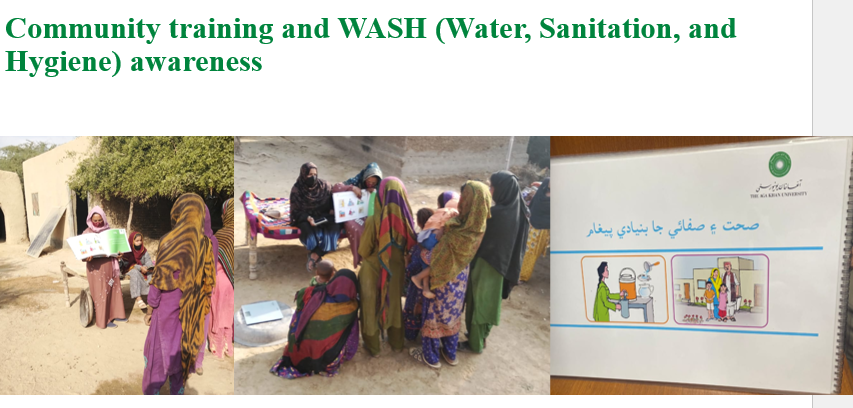
A quasi-experimental study enrolled 975 households with children under five, divided into three groups of 325. Two intervention groups received household water filters combined with hygiene education, with one filter targeting bacterial contamination and the other targeting both bacterial and viral contamination. The control group received hygiene education and water coolers for safe water storage. The programme included household surveys, water-quality testing, child health and nutrition measurements, filter installation, community engagement, and training on handwashing, safe water storage, and filter maintenance. Households were followed for nine months.
Improved Water Quality and Child Health Outcomes
The intervention demonstrated strong results after nine months. Among the 650 intervention households, filter use exceeded 99%, demonstrating high acceptance and sustained adoption. In the bacterial-filter group, E. coli contamination declined from 50% to 5.6%, while total coliform contamination fell from 70.5% to 16.7%. In the bacterial-plus-viral filter group, E. coli contamination decreased from 61.9% to 5%, while total coliform contamination declined from 95.2% to 25%.
Child health outcomes also improved substantially. Diarrhea prevalence declined from 3.6% to 2.0% in the bacterial-filter group and from 3.3% to 0% in the bacterial-plus-viral group. Underweight decreased from 51.8% to 11.3% and from 37.7% to 11.4%, respectively. Wasting declined from 23.0% to 3.6% and from 15.1% to 5.7%, while stunting also decreased in both intervention groups. The findings demonstrate the potential of combining point-of-use water treatment with sustained WASH education and household monitoring to protect children in climate-vulnerable communities.
Affordable and Scalable Climate Resilience Solution
The solution is designed to be affordable and practical for low-resource and disaster-affected settings. The FairCap household filter costs approximately PKR 1,697 (around USD 6) for two years of use and requires neither electricity nor fuel. This compares with approximately USD 12.90 for two years of chlorination and around USD 130 for boiling water, making filtration a potentially more accessible long-term option for vulnerable households.
The innovation is currently at the pre-pilot / preparing-for-field-testing stage and is seeking scale-up funding, government and WASH implementation partners, policy support, and local manufacturers. Existing partners include Aga Khan University, the Pakistan Council of Research in Water Resources, and Grand Challenges Canada. Future scale-up will focus on local filter production, integration into disaster-response, nutrition, and primary healthcare programmes, and replication in other flood-prone communities using existing local supply and training networks.