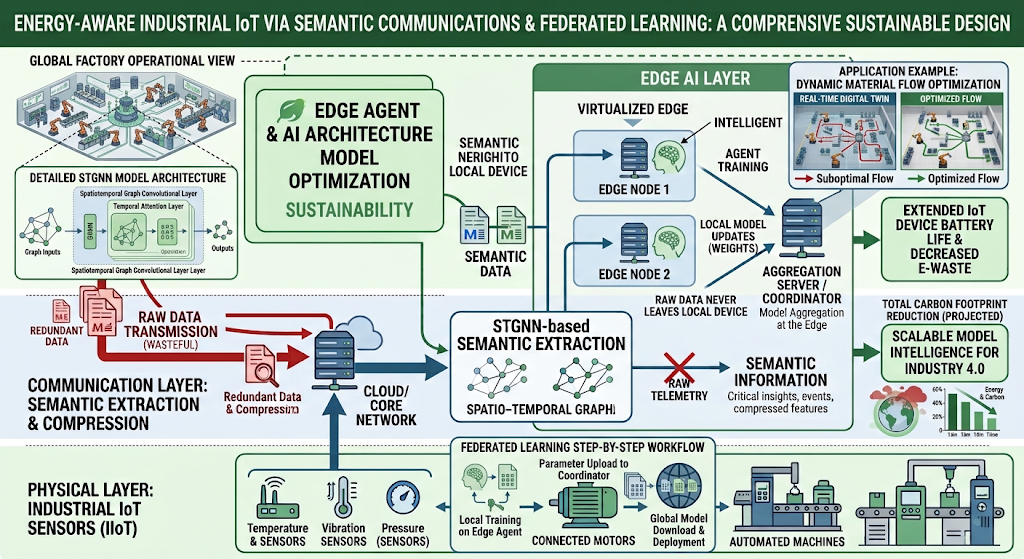
Leveraging AI-driven semantic communications and decentralized federated learning to reduce the energy consumption of Industry 4.0 networks, extend IoT device lifetimes, reduce electronic waste, and enable more sustainable smart manufacturing.
Date:
-
Location:
Turkey
Partners:
-
Research Area:
Energy-Efficient Industrial IoT, AI, Semantic Communications & Industrial Decarbonization
Sustainable Development Goals:
07 - Affordable and Clean Energy, 09 - Industry, Innovation and Infrastructure, 12 - Responsible Consumption and Production, 13 - Climate Action
Challenge
The transition toward Industry 4.0 has led manufacturing facilities to deploy thousands of sensors that continuously collect and transmit information about machines, production processes, environmental conditions, and equipment performance. Much of this telemetry is sent as raw data to centralized cloud platforms for storage and analysis.
While this architecture enables advanced monitoring and automation, it also creates a largely hidden energy burden. Continuous sensing, wireless transmission, routing, and cloud-based processing require substantial computing and communication resources. As the number of connected industrial devices continues to grow, the resulting electricity consumption can become a significant and rapidly increasing component of the carbon footprint of smart manufacturing.
The challenge is therefore not simply to collect more industrial data, but to determine which information actually needs to be communicated and how it can be processed with substantially lower energy requirements.
Solution and Innovation
The proposed framework introduces a meaning-centric communication architecture in which industrial sensors do not continuously transmit their complete raw telemetry. Instead, Spatio-Temporal Graph Neural Networks are used to identify relevant patterns and extract the semantic information contained within the data.
Rather than communicating every measurement, sensors can transmit information such as critical state changes, anomalies, relevant events, or actionable insights. This significantly reduces the volume and duration of wireless communication required between industrial devices and computing infrastructure.
The approach is complemented by Agentic Federated Learning, allowing intelligent agents located at the industrial edge to collaboratively improve predictive models without continuously transferring raw sensor data to centralized cloud servers. Models can therefore benefit from information across an industrial network while keeping much of the computational and data-processing activity close to where the data is generated.
The combination of semantic communication and decentralized learning represents the core innovation: reducing both communication requirements and centralized computing demand while retaining the information necessary for intelligent industrial operations.
Climate and Circular Economy Impact
Reducing radio-frequency transmission and cloud-based processing can directly lower the electricity required to operate Industry 4.0 communication networks. This creates a pathway toward lower-carbon smart manufacturing infrastructure, particularly as industrial networks evolve toward increasingly connected 5G and 6G environments.
The benefits can also extend to the industrial devices themselves. Lower communication requirements can reduce the power consumption of individual sensors, potentially extending battery life and reducing the frequency with which devices need to be replaced or serviced. In the longer term, the approach could support low-power or energy-harvesting sensors capable of operating with minimal external energy requirements.
This creates an additional circular-economy benefit by reducing battery consumption, extending hardware lifetimes, and potentially decreasing electronic waste generated by large-scale industrial sensor deployments. The project therefore connects AI, telecommunications, energy efficiency, industrial digitalization, and circular resource use.
Development Stage and Validation
The innovation is currently at the Prototype in Development stage. The proposed architecture remains at the laboratory and methodology-development level, and its projected energy and carbon benefits have not yet been demonstrated through an industrial deployment.
The next development stage is to conduct Python-based edge simulations to validate the underlying algorithms and quantify the potential reductions in communication and computing energy consumption. Following this initial validation, the team plans to deploy the framework in a containerized environment on an IEEE 5G/6G Innovation Testbed to evaluate its performance under more realistic network conditions.
These steps are intended to establish the technical feasibility of the approach before progressing toward pilot testing in an operational industrial environment.
Scalability and Deployment Potential
The architecture is fundamentally software-defined, meaning that its scalability does not depend on replacing existing manufacturing equipment with entirely new hardware. Instead, the approach focuses on optimizing how information is generated, processed, and transmitted within existing and future IIoT networks.
This provides potential applications across a wide range of industrial environments, including automotive manufacturing, automated production facilities, industrial plants, and smart logistics centres. Once validated, the underlying algorithms could potentially be adapted to different sensor configurations, communication infrastructures, and industrial use cases.
The approach is particularly relevant to the future development of energy-efficient 5G and 6G industrial networks, where the number of connected devices and the volume of machine-generated data are expected to increase substantially.
Partnerships and Support
Mudanya University is seeking industrial partners that can provide real-world industrial sensor datasets for the initial simulation and validation phase. Manufacturing companies and smart logistics centres could subsequently provide operational environments for pilot testing.
The team is also seeking telecommunications and technology partners to support integration with future 6G and O-RAN testbed environments, as well as early-stage funding to develop and validate the prototype.
Through collaboration with industry, telecommunications providers, research organisations, and technology partners, the project aims to demonstrate that smarter communication—not simply less digitalization—can make the next generation of smart manufacturing significantly more energy efficient and climate compatible.