A proven framework helping industrial parks reduce resource use, recover value from waste, and advance industrial decarbonization through circular resource partnerships.
Date:
2010 - 2025
Location:
Malaysia
Partners:
Ministry of Investment, Trade and Industry (MITI); Malaysian Investment Development Authority (MIDA)
Research Area:
Decarbonizing Industry & Circular Economy
Sustainable Development Goals:
08 - Decent Work and Economic Growth, 09 - Industry, Innovation and Infrastructure, 12 - Responsible Consumption and Production, 13 - Climate Action, 17 - Partnerships for the Goals
Building Low-Carbon Industrial Ecosystems
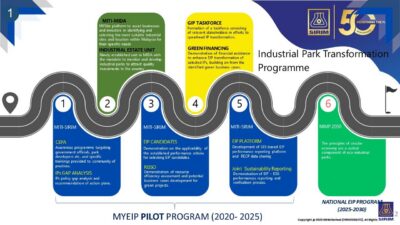
SIRIM Berhad has developed the Malaysia Eco-Industrial Park (MYEIP) framework to help transform conventional industrial parks into resource-efficient, circular, and low-carbon ecosystems. Implemented from 2020 to 2025, the initiative addresses a common challenge in industrial parks: companies often operate independently, while park managers, regulators, technology providers, and financiers work with fragmented information. This makes it difficult to identify opportunities for resource efficiency, industrial symbiosis, by-product recovery, and emissions reduction.
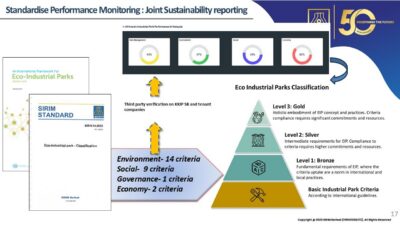
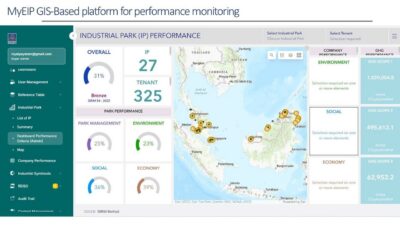
MYEIP provides a structured pathway from assessment to implementation. It combines engagement with industrial park managers and tenants, Resource Efficiency and Industrial Symbiosis Opportunity (REISO) assessments, technology matching, feasibility and techno-economic studies, business development, and performance monitoring. A GIS-based MyEIP Platform brings resource efficiency and industrial symbiosis information together, supported by the SIRIM 54:2022 criteria for Eco-Industrial Park classification and performance, including environmental, social, governance, and economic indicators.
Demonstrated Resource Efficiency and Industrial Symbiosis
The framework has already demonstrated significant scale and real-world impact. 48 industrial parks in Malaysia have been assessed against SIRIM 54 performance criteria, with 12 successfully completing the assessment, while 27 industrial parks and more than 325 tenant companies are engaged through the MyEIP Platform. In addition, 60 tenant companies have participated in REISO assessments.
The approach has identified practical opportunities including energy efficiency, by-product reuse, waste heat recovery, biomass utilization, and industrial symbiosis. At Kota Kinabalu Industrial Park, for example, a REISO energy audit identified a 5.78% energy-saving opportunity for a bottled water manufacturer. Samalaju Industrial Park also achieved Bronze classification through third-party verification against SIRIM 54:2022, with the approach subsequently being replicated at Kota Kinabalu Industrial Park.
Beyond identifying opportunities, the platform helps connect businesses with technology providers, financiers, and potential commercial partners. This creates a pathway for moving resource-efficiency opportunities from initial assessment toward viable business cases and implementation.
National Implementation and International Replication
The solution is currently at the pilot-tested stage and has provided the foundation for Malaysia’s next phase of Eco-Industrial Park development. Lessons from the MYEIP pilot on performance criteria, digital monitoring, REISO, business matching, financing, and verification are being incorporated into Malaysia’s National Eco-Industrial Park Programme.
The framework is designed to be adapted rather than simply replicated, allowing industrial regions in other emerging economies to tailor the approach to their local industrial, regulatory, and economic conditions. SIRIM is seeking industrial parks, governments, research organizations, investors, and development partners to support international replication, platform scale-up, project financing, and adaptation of the model to new regions.