Kenya faces a growing mismatch between workforce skills and emerging green jobs. Limited access to practical green, digital, and sustainability skills leaves many workers, youth, and vulnerable groups unable to adapt, secure decent employment, or participate fully in the green economy.
Date:
-
Location:
Kenya
Partners:
-
Research Area:
Climate-Responsive Societies & Just Transitions
Sustainable Development Goals:
04 - Quality Education, 05 - Gender Equality, 08 - Decent Work and Economic Growth, 09 - Industry, Innovation and Infrastructure, 13 - Climate Action
Challenge
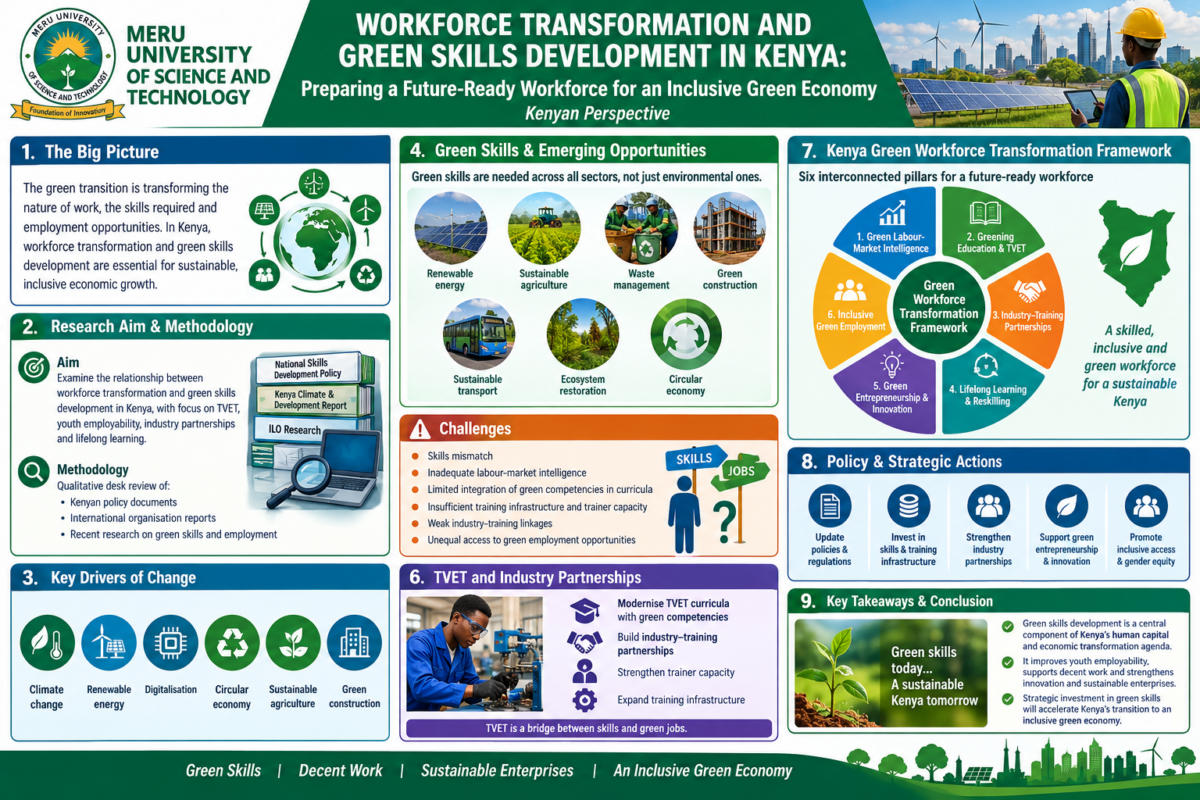
A growing mismatch exists between the skills provided through workforce training and the competencies demanded by Kenya’s emerging green economy. Workers increasingly require environmental, digital, technical, and sustainability-related capabilities, yet many training pathways have not sufficiently adapted to these changing requirements. Limited access to relevant practical skills can leave workers, youth, and vulnerable groups at risk of unemployment, underemployment, or exclusion from opportunities generated by the green transition.
The challenge extends across sectors including renewable energy, sustainable agriculture, green construction, waste management, circular economy, sustainable transport, and ecosystem restoration. Stronger connections between training institutions and employers are therefore required to ensure that curricula and practical learning opportunities reflect real workplace needs and provide clear pathways into emerging green occupations.
Solution and Innovation
The initiative provides practical and accessible green-skills training that integrates sustainability, digital competencies, and workplace skills. Rather than focusing solely on theoretical knowledge, the approach connects learning directly with emerging employment opportunities through targeted training, industry partnerships, and structured skills pathways. This enables participants to develop competencies that are relevant to both changing existing occupations and newly emerging green jobs.
The broader approach is supported by the Kenya Green Workforce Transformation Framework, which identifies six complementary areas for workforce transformation: green labour-market intelligence, greening education and TVET, industry partnerships, lifelong learning and reskilling, green entrepreneurship and innovation, and inclusive green employment. Practical implementation can include modular training, digital learning, industry placements, certification, and train-the-trainer models, allowing green-skills provision to reach different groups of workers and young people.
Expected Impact
The initiative aims to create a future-ready workforce equipped with practical competencies for emerging green jobs. It is designed to improve employability, support decent livelihoods, strengthen business competitiveness, and enable more Kenyans—particularly youth and vulnerable groups—to participate in the opportunities created by the green economy. The initiative will measure its impact through indicators including trainees reached, completion rates, certifications earned, employment outcomes, and industry partnerships.
By strengthening the link between skills development and labour-market demand, the initiative also supports Kenya’s wider transition towards an inclusive, innovative, and climate-resilient economy. Better access to practical green skills can help workers adapt to technological and environmental change while providing businesses with access to a more appropriately skilled workforce.
Development and Scale-Up
The initiative is currently Pilot Tested (real-world conditions, limited scale). The next phase focuses on expanding training and certification for workers and youth and strengthening connections between participants and emerging green-job opportunities. Partnerships with training institutions, employers, government, and development organizations will provide the basis for wider implementation.
The solution can be scaled across Kenyan counties through standardized training modules, digital learning, and train-the-trainer models, while allowing content to be adapted to local green-job opportunities and labour-market conditions. The initiative is seeking funding, pilot partnerships, technical expertise, curriculum-development support, industry linkages, certification support, and policy collaboration to expand green-skills training and employment pathways across Kenya.