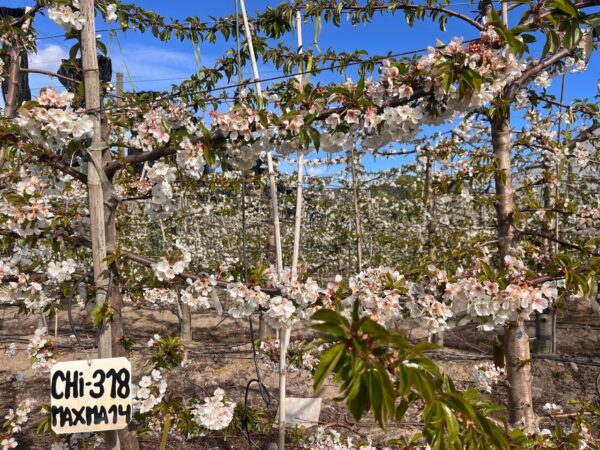
For fourteen years, the Sweet Cherry Breeding Program (PMGCe) at Pontificia Universidad Católica de Chile has developed new sweet cherry varieties adapted to Chile’s changing climate while meeting the quality requirements of international export markets. The program focuses on low-chill, early-ripening varieties with greater tolerance to heat, drought, erratic rainfall, fruit cracking, and double fruit formation, while maintaining the size, firmness, sweetness, colour, and postharvest life required for long-distance exports to Asia.
Date:
-
Location:
Chile
Partners:
Pontificia Universidad Católica de Chile
Research Area:
Climate Resilience & the Water–Food–Energy Nexus
Sustainable Development Goals:
02 - Zero Hunger, 08 - Decent Work and Economic Growth, 12 - Responsible Consumption and Production, 13 - Climate Action, 15 - Life On Land
The Sweet Cherry Breeding Program (PMGCe) at Pontificia Universidad Católica de Chile (PUC) has spent fourteen years developing sweet cherry varieties capable of maintaining productivity and fruit quality under increasingly challenging climatic conditions. The program combines climate resilience with the stringent quality requirements of international markets, particularly Asian markets, which represent Chile’s main export destination for sweet cherries.
Climate Challenges in Chilean Cherry Production
Central Chile has historically provided favourable Mediterranean conditions for sweet cherry production. However, climate change is increasingly altering these conditions. Warmer winters are reducing the accumulation of winter chill required for normal dormancy release, increasing growers’ dependence on dormancy-breaking agents.
At the same time, summers are becoming drier and hotter, with elevated solar radiation contributing to double fruit formation. Increasingly variable spring conditions can bring cold, cloudy and rainy weather during flowering and pollination, while unseasonal rainfall near harvest can compromise fruit quality. Unpredictable rainfall during fruit development also increases the risk of fruit cracking, one of the most damaging disorders affecting cherry production.
These changes threaten both productivity and the ability of Chilean growers to consistently produce export-quality fruit.
Climate-Resilient Breeding and Innovation
PMGCe addresses these challenges through long-term breeding and selection of genotypes specifically adapted to the changing conditions of central Chile.
A central objective is the development of early-ripening, low-chill varieties that require less winter chilling and can perform under warmer conditions. The program also prioritizes tolerance to fruit cracking, heat waves, extreme drought and erratic rainfall, as well as reduced susceptibility to double fruits.
Climate resilience is combined with the quality characteristics required by international markets. Candidate varieties are selected for large fruit size, firmness, sweetness, attractive colour, low incidence of physiological disorders and excellent postharvest performance. Strong postharvest life is particularly important for Chilean exports because fruit may spend weeks in transport before reaching Asian markets.
From Breeding to Field Evaluation and Commercialization
After fourteen years of breeding and selection, the program has identified three advanced early-ripening selections that have entered the scaling phase. Starting in 2026, these selections will be evaluated for quality, yield and postharvest performance over two to three seasons as they progress toward potential variety registration.
In parallel, approximately 1,000 promising individuals have been grafted onto rootstock and established across four sites in central Chile representing different climatic conditions. This multisite evaluation will generate field data on adaptability, performance and stability and support the identification of additional advanced selections.
By 2030, the program expects to have at least one registered variety and four advanced selections undergoing multisite and multi-rootstock evaluation.
Environmental, Social and Economic Impact
The development of low-chill varieties can reduce dependence on dormancy-breaking agents, while improved tolerance to climatic stresses can contribute to more resilient and potentially less chemical-intensive production systems.
The project also has important socioeconomic implications. By helping maintain productive cherry orchards under changing climatic conditions, the breeding program supports rural employment and livelihoods while strengthening the competitiveness of Chile’s cherry industry in international markets.
The program is currently working with technology partners and companies hosting PMGCe germplasm for pre-commercial evaluation. It is seeking additional partners interested in supporting cherry breeding through funding, additional evaluation sites and commercial-scale collaboration.