An integrated community-based approach combining health education, nutrition, climate-smart agriculture and women’s empowerment through Food, Agriculture and Nutrition (FAN) Clubs, building resilient rural communities through collective action and knowledge transfer.
Date:
Location:
Zimbabwe, Botswana
Partners:
Botswana University of Agriculture (BUAN)
Research Area:
Climate Resilience & the Water–Food–Energy Nexus
Sustainable Development Goals:
02 - Zero Hunger, 03 - Good Health and Well-Being, 05 - Gender Equality, 06 - Clean Water and Sanitation, 08 - Decent Work and Economic Growth, 13 - Climate Action
Integrated Community Engagement for Climate Resilience
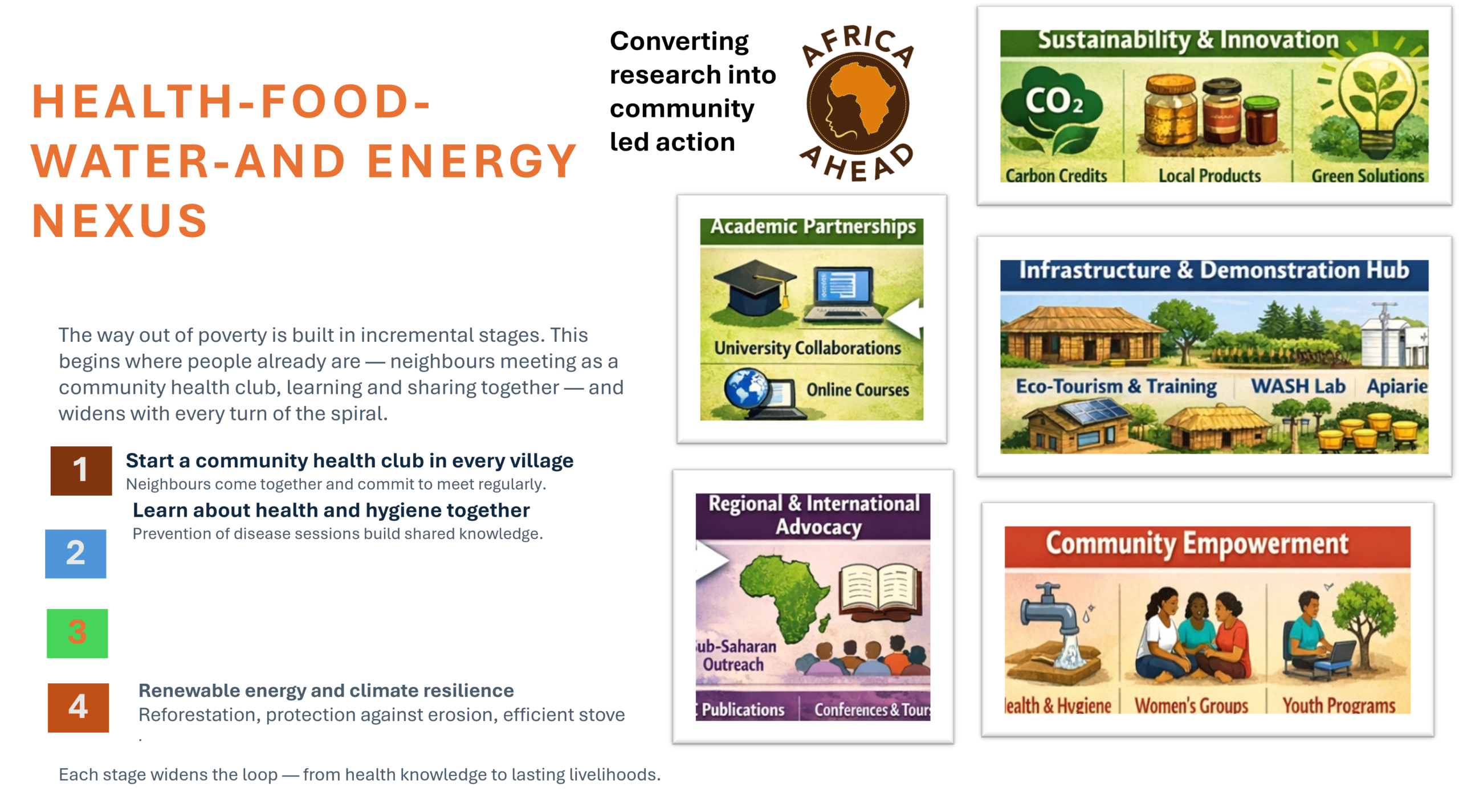
Africa AHEAD has developed a community-based approach to climate adaptation and resilience that combines health education, agriculture, nutrition, water management, and livelihood development. The methodology builds on the Community Health Club (CHC) model and extends it through Food, Agriculture and Nutrition (FAN) Clubs, creating an integrated platform through which rural communities can collectively respond to climate and development challenges.
The approach is particularly relevant to Zimbabwe and Botswana, where smallholder farmers face increasing drought, desertification, and climate variability. Through regular group-based training, communities learn practical measures including soil and water conservation, mulching, fertility trenching, drought-resistant crops, intercropping, tree nurseries, beekeeping, livestock health management, and the use of digital agricultural extension services. Nutrition gardens and income-generating activities are intended to strengthen both food security and household resilience.
Proven Community-Level Impact
The AHEAD methodology is already in operational deployment, having been applied over approximately 30 years across 13 African countries. Around 20,000 community clubs have been established, with reported benefits reaching more than 8 million family members through improvements in hygiene, health, and nutrition.
The proposed FAN extension builds on this established community infrastructure by connecting health and agricultural development rather than addressing them through separate programmes. Women are a particular focus, with the initiative seeking to strengthen their technical knowledge, digital skills, control over resources, and ability to generate income and invest in household wellbeing. The approach is based on collective participation and the principle that entire communities can adopt practices together rather than relying on gradual individual-level uptake.
Research, Replication and Scale-Up
The next stage is to conduct systematic research measuring the additional impact of FAN Clubs compared with Community Health Clubs focused solely on health education. Over a three-year period, the research will assess changes in hygiene and sanitation, agricultural practices, household income, health and nutrition outcomes, water management, and women’s empowerment.
Africa AHEAD aims to establish evidence that can inform national policy and institutional adoption across Africa. The methodology can be adapted to different local agricultural and climate conditions and integrated into existing government and development structures. The organization is seeking long-term research funding and committed implementation partners to establish pilot projects across African countries and demonstrate how integrated community engagement can strengthen climate resilience at scale.