
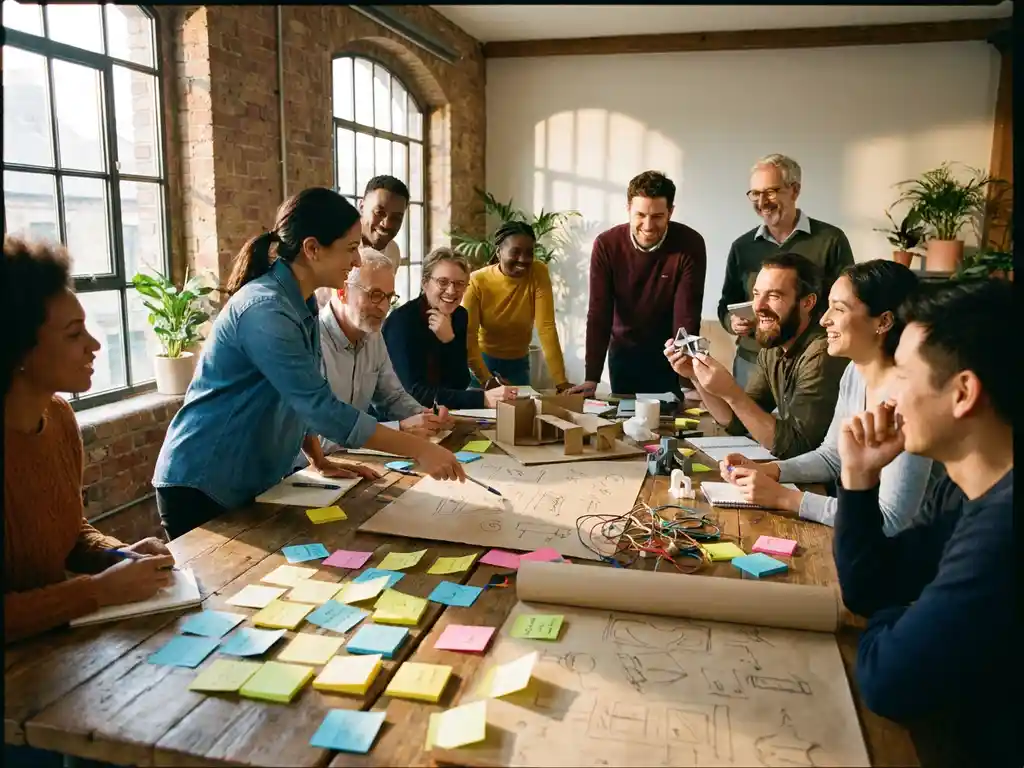
Preparing for an innovation co-creation workshop requires strategic planning across five key areas: defining clear objectives, selecting the right participants, gathering essential materials and tools, structuring an effective agenda, and implementing proven facilitation techniques. Success depends on thorough preparation that aligns stakeholder expectations, creates psychological safety for creative thinking, and establishes concrete pathways from ideation to implementation.
Poor participant selection is undermining your workshop outcomes
Most co-creation workshops fail because organizers invite the wrong mix of people or too many participants from similar backgrounds. When everyone thinks alike, you get incremental improvements instead of breakthrough innovations. Homogeneous groups create echo chambers that reinforce existing assumptions and miss critical perspectives. To fix this, intentionally recruit participants with diverse expertise, different organizational roles, and varying problem-solving approaches. Aim for cognitive diversity over demographic diversity, ensuring you include both technical specialists and end-user representatives who can challenge conventional thinking.
Vague objectives are wasting your collaborative energy
Workshops without specific, measurable goals become expensive brainstorming sessions that produce lists of ideas but no actionable outcomes. Participants leave energized but confused about next steps, and promising concepts die in follow-up meetings. This happens when organizers focus on the creative process instead of defining what success looks like. Combat this by establishing concrete deliverables before the workshop begins. Define exactly what decisions need to be made, what prototypes should emerge, or what implementation plans must be created. Share these objectives with participants in advance so they arrive prepared to contribute meaningfully.
What is an innovation co-creation workshop and why does it matter?
An innovation co-creation workshop is a structured, collaborative session in which diverse stakeholders work together to solve complex problems and develop new solutions. It combines different perspectives, expertise, and experiences to generate breakthrough innovations that no single participant could create alone.
Co-creation workshops matter because they address the limitations of traditional innovation approaches. When organizations rely solely on internal teams or external consultants, they miss crucial insights from users, partners, and cross-functional colleagues. These workshops create a controlled environment where participants can share knowledge freely, challenge assumptions safely, and build on each other’s ideas without organizational barriers.
The collaborative methodology produces more robust solutions because it incorporates multiple viewpoints from the start. Rather than developing solutions in isolation and seeking feedback later, co-creation embeds diverse perspectives into the innovation process itself. This reduces the risk of developing products or services that fail to meet real-world needs.
Who should participate in an innovation co-creation workshop?
Effective co-creation workshops include 6–12 participants representing different stakeholder groups, areas of expertise, and organizational levels. The ideal mix combines internal team members, external partners, end users, and subject matter experts who can contribute unique perspectives to the challenge at hand.
Internal participants should span multiple departments and levels of seniority. Include both decision-makers who can authorize implementation and front-line employees who understand operational realities. Technical specialists bring deep knowledge, while generalists offer broader perspectives on feasibility and market fit.
External participants add critical outside viewpoints. End users or customers provide real-world insights into needs and pain points. Partners or suppliers understand ecosystem constraints and opportunities. Academic researchers or industry experts contribute cutting-edge knowledge and methodological rigor.
Avoid inviting too many senior executives, as their presence can inhibit open discussion. Similarly, limit participants with overlapping expertise to prevent groupthink. The goal is cognitive diversity that generates creative tension and comprehensive problem-solving.
How do you define objectives and scope for a co-creation workshop?
Define workshop objectives by identifying specific, measurable outcomes you need to achieve within a clearly bounded problem space. Start with the end goal and work backward to determine what decisions, prototypes, or plans must emerge from the session.
Begin by articulating the core challenge in one clear sentence. Avoid broad statements like “improve customer experience” and instead focus on specific problems like “reduce customer onboarding time from 30 days to 10 days while maintaining quality standards.” This specificity helps participants understand exactly what they are solving.
Set concrete deliverables that participants can evaluate objectively. Examples include validated concept prototypes, implementation roadmaps with assigned owners, or decision frameworks with clear criteria. These tangible outputs ensure the workshop produces actionable results rather than just interesting discussions.
Establish scope boundaries to prevent the session from expanding beyond manageable limits. Define which aspects of the problem are in scope, which constraints must be respected, and which topics are explicitly out of bounds. Share these parameters with participants beforehand so they can prepare relevant expertise and examples.
What materials and tools do you need for an innovation workshop?
Essential materials include large-format paper, sticky notes, markers, timers, and digital collaboration tools. The specific toolkit depends on your chosen methodology, but most successful workshops combine analog tools for rapid ideation with digital platforms for documentation and remote participation.
Physical materials enable tactile engagement that stimulates creative thinking. Provide multiple colors of sticky notes for categorizing ideas, flip chart paper for group mapping exercises, and quality markers that won’t bleed through the paper. Include dot stickers for voting exercises and masking tape for creating workspace boundaries.
Digital tools become essential for hybrid workshops or complex documentation needs. Collaboration platforms like Miro or Mural allow remote participants to contribute equally while preserving all workshop outputs in organized formats. Use shared documents for real-time note-taking and project management tools for tracking follow-up actions.
Prepare methodology-specific materials based on your chosen innovation framework. Design thinking workshops need persona templates and journey-mapping canvases. Lean startup approaches require assumption-mapping sheets and experiment-design templates. Business model innovation sessions use canvas formats for systematic exploration.
How do you structure the agenda for maximum collaboration?
Structure your agenda using a divergent-convergent flow that alternates between idea generation and decision-making phases. Begin with individual reflection, expand into small group discussions, then converge on shared priorities through full-group activities.
Start with a 30-minute alignment session in which participants share their perspectives on the challenge and establish a common vocabulary. This prevents misunderstandings and ensures everyone works from the same baseline knowledge. Include brief introductions that highlight relevant expertise rather than just job titles.
Design the core workflow in 90-minute blocks separated by 15-minute breaks. Each block should have a clear purpose: problem exploration, solution ideation, concept development, or implementation planning. Within each block, alternate between individual work, small-group collaboration, and full-group sharing to maintain energy and engagement.
Reserve the final session for concrete next steps and accountability. Don’t end with vague commitments to “follow up soon.” Instead, assign specific owners to each action item, set deadlines, and schedule the first check-in meeting before participants leave.
What facilitation techniques ensure productive co-creation sessions?
Effective facilitation combines structured activities with adaptive responses to group dynamics. Use timeboxing to maintain momentum, establish ground rules that encourage psychological safety, and employ techniques like “yes, and” thinking to build on ideas rather than critique them immediately.
Implement the “no idea is a bad idea” rule during divergent phases, but balance it with structured evaluation criteria during convergent phases. Use silent brainstorming before group discussions to ensure all voices are heard, not just the loudest participants. Rotate small-group compositions throughout the day to cross-pollinate thinking.
Manage energy levels by varying activity types and physical arrangements. Alternate between standing and sitting exercises, individual reflection and group interaction, creative tasks and analytical work. Use energizer activities when attention wanes, but keep them brief and relevant to the workshop goals.
Document everything visually and make the process transparent. Use flip charts to track key insights, decisions, and parking lot items for off-topic but valuable ideas. Regularly summarize progress and check alignment with objectives to ensure the group stays focused on producing concrete outcomes.
How WAITRO Helps with Innovation Co-Creation Workshops
At WAITRO, we understand that successful innovation co-creation requires more than just bringing people together in a room. As the world’s largest network of research and technology organizations, we provide comprehensive support for collaborative innovation initiatives through our global platform and expertise.
Our services include:
- Facilitating cross-border partnerships between research organizations and industry partners
- Providing access to diverse expertise through our network of 135 Full Members and 45 Associate Members
- Offering capacity development programs that strengthen innovation methodologies
- Creating platforms for knowledge sharing and collaborative problem-solving
- Supporting the development of innovation ecosystems aligned with the UN Sustainable Development Goals
We invite you to join us at the WAITRO Summit 2026 in Istanbul, Türkiye, from October 26–28, 2026. This year’s theme, “Leading the Path of Implementation: Strengthening Co-Creation for Our Common Future,” directly addresses the collaborative innovation challenges discussed in this article. The Summit provides an unparalleled opportunity to connect with global innovators, participate in hands-on co-creation sessions, and become part of a movement shaping sustainable innovation for our shared future. Become a member today to access our full range of collaborative innovation resources and join a community committed to addressing global challenges through collective action.
