
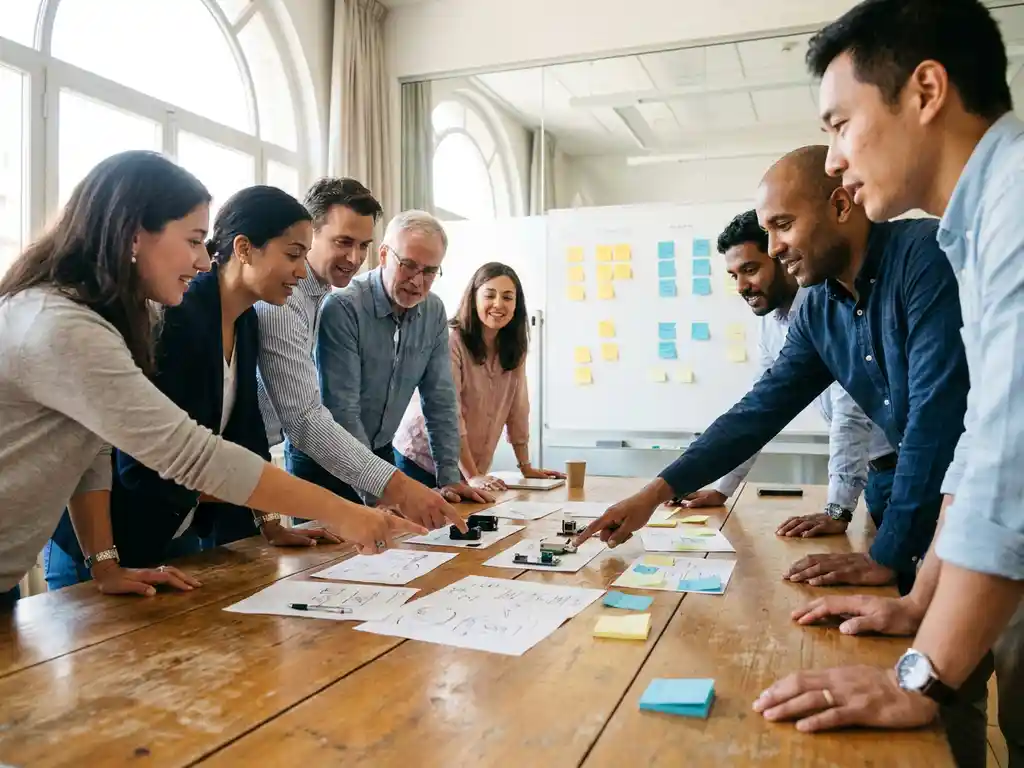
Co-creation workshops transform abstract ideas into concrete projects by bringing diverse stakeholders together in structured, collaborative sessions. These workshops use facilitated activities, design thinking methods, and collective problem-solving to refine concepts, identify resources, and create actionable implementation plans that move beyond brainstorming into real-world execution.
Scattered ideas without structure waste your team’s creative potential
When teams generate ideas in isolation or through unstructured brainstorming sessions, most concepts never progress beyond initial enthusiasm. Ideas remain fragmented, lack clear ownership, and miss critical perspectives that could strengthen their viability. This scattered approach means valuable insights get lost, team members feel disconnected from the innovation process, and organizations struggle to build momentum around promising concepts. Focus on creating structured environments where ideas can be systematically developed, tested, and refined through collaborative input from multiple stakeholders.
Traditional planning methods are blocking breakthrough innovation
Conventional project planning often starts with predetermined solutions and follows rigid, linear processes that discourage creative exploration. This approach limits input to a small group of decision-makers and creates projects that feel imposed rather than co-owned by the team. The result is lower engagement, missed opportunities for innovative approaches, and solutions that don’t fully address user needs or market realities. Shift toward collaborative planning methods that invite diverse perspectives early in the process and allow solutions to emerge through iterative exploration and collective insight.
What are co-creation workshops and why do they matter?
Co-creation workshops are structured, collaborative sessions where diverse participants work together to develop ideas, solve problems, and create actionable plans. They matter because they combine multiple perspectives, areas of expertise, and stakeholder insights to produce more robust and implementable solutions than traditional planning methods.
These workshops create a shared space where participants contribute their unique knowledge and experience to shape project outcomes. Unlike traditional meetings where a few voices dominate, co-creation workshops use facilitated activities that ensure everyone participates meaningfully. This collaborative approach leads to better problem understanding, more creative solutions, and stronger buy-in from all stakeholders.
The structured nature of these sessions prevents common pitfalls like endless discussion without progress or solutions that work for only one stakeholder group. Through guided activities and time-boxed exercises, participants move systematically from problem exploration to concept development to implementation planning.
How do co-creation workshops generate actionable project ideas?
Co-creation workshops generate actionable project ideas through structured activities that move participants from broad exploration to specific implementation plans. They use techniques like problem mapping, solution ideation, feasibility assessment, and resource planning to ensure ideas become concrete projects with clear next steps.
The process typically begins with problem-definition activities where participants share different perspectives on the challenge at hand. This creates a comprehensive understanding of the issue from multiple angles. Next come divergent-thinking exercises where participants generate numerous potential solutions without immediate judgment or filtering.
The critical transformation happens during convergence activities, where participants evaluate ideas against practical criteria like feasibility, impact, and available resources. This evaluation process naturally filters concepts and identifies the most promising directions. Finally, action-planning activities help participants define specific steps, assign responsibilities, and establish timelines for moving forward.
What’s the difference between co-creation and traditional project planning?
Co-creation involves multiple stakeholders collaboratively developing solutions from the ground up, while traditional project planning typically starts with predetermined goals and follows linear execution paths. Co-creation emphasizes exploration and emergence, whereas traditional planning focuses on control and predictability.
Traditional project planning often begins with a clear problem statement and solution direction determined by leadership or a small planning team. The focus is on breaking down known work into manageable tasks and creating detailed schedules and resource allocations. This approach works well for routine projects with well-understood requirements and proven methods.
Co-creation workshops, by contrast, start with broader problem exploration and allow solutions to emerge through collaborative discovery. Participants might include end users, technical experts, business stakeholders, and external partners, each of whom brings different perspectives to the challenge. The emphasis is on learning and adapting rather than executing a predetermined plan.
Who should participate in co-creation workshops for maximum impact?
Effective co-creation workshops include diverse participants who bring different perspectives, expertise, and stakes in the project outcome. The ideal mix includes end users, subject matter experts, decision-makers, implementers, and external partners who can contribute unique insights and ensure comprehensive solution development.
End users or beneficiaries provide crucial insights about real-world needs and constraints that solutions must address. Their participation ensures projects remain grounded in actual requirements rather than assumptions. Technical experts contribute knowledge about what’s possible and help identify potential implementation challenges early in the process.
Decision-makers need to participate to understand the rationale behind emerging solutions and provide real-time feedback about organizational constraints and priorities. Including implementers ensures that resulting plans are realistic and consider operational realities. External partners can offer fresh perspectives and identify collaboration opportunities that internal teams might miss.
How do you structure a co-creation workshop for project success?
Structure co-creation workshops using a clear progression from problem understanding through solution development to action planning. Begin with divergent activities that explore the challenge broadly, move through convergent activities that focus on promising directions, and conclude with concrete planning that defines next steps and responsibilities.
Start with warm-up activities that help participants understand each other’s perspectives and establish psychological safety for open contribution. Follow with problem-exploration exercises like stakeholder mapping or journey mapping that create a shared understanding of the challenge. Use structured ideation techniques to generate numerous potential solutions without immediate evaluation.
The middle phase focuses on evaluation and refinement. Guide participants through activities that assess ideas against relevant criteria like feasibility, impact, and alignment with organizational goals. Help teams combine and build upon the strongest concepts to create more comprehensive solutions.
Conclude with action planning that transforms selected concepts into concrete next steps. Define specific deliverables, assign responsibilities, establish timelines, and identify required resources. End with commitment activities where participants explicitly agree to their roles in moving forward.
How WAITRO Helps with Co-Creation and Collaborative Innovation
We facilitate co-creation workshops and collaborative innovation through our global network of research and technology organizations. Our approach brings together diverse stakeholders to address complex challenges and advance sustainable development goals through structured collaboration. Here’s how we support co-creation initiatives:
- Connect organizations across regions and sectors through our network of 135 Full Members and 45 Associate Members
- Provide structured programs and services that facilitate cross-border partnerships and knowledge sharing
- Offer capacity development opportunities that strengthen collaborative innovation capabilities
- Support innovation ecosystems that bring research organizations together with industry partners
- Create platforms for sharing best practices in collaborative project development
The upcoming WAITRO Summit 2026 exemplifies our commitment to co-creation. Taking place October 26-28, 2026, in Istanbul, Türkiye, the Summit’s theme, “Leading the Path of Implementation: Strengthening Co-Creation for Our Common Future,” directly addresses collaborative innovation challenges. This event brings together global innovators, researchers, and industry leaders to engage in co-creation activities and develop solutions for sustainable development. Join our network to participate in this transformative gathering and connect with organizations worldwide that are pioneering collaborative approaches to innovation and sustainable development.
