A low-energy electrochemical technology that selectively recovers high-purity lithium from complex industrial and battery recycling streams to support a circular battery economy.
Date:
-
Location:
Spain
Partners:
-
Research Area:
Decarbonizing Industry & Circular Economy
Sustainable Development Goals:
07 - Affordable and Clean Energy, 09 - Industry, Innovation and Infrastructure, 12 - Responsible Consumption and Production, 13 - Climate Action
Sustainable Lithium Recovery for a Circular Battery Economy
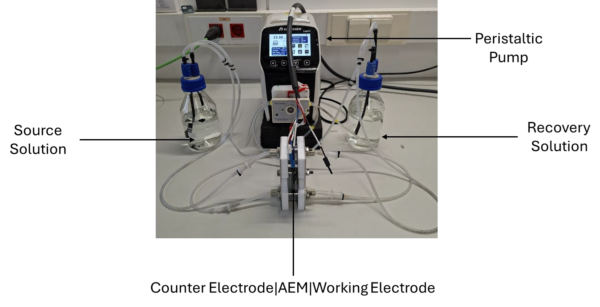
Leitat Technological Center is developing an advanced electrochemical lithium recovery technology, known as electrochemical ion pumping, to selectively recover lithium from complex aqueous streams generated by battery recycling, mining, and industrial processes. The technology addresses the growing demand for lithium driven by electric mobility and renewable energy storage, while reducing Europe’s dependence on imported critical raw materials.
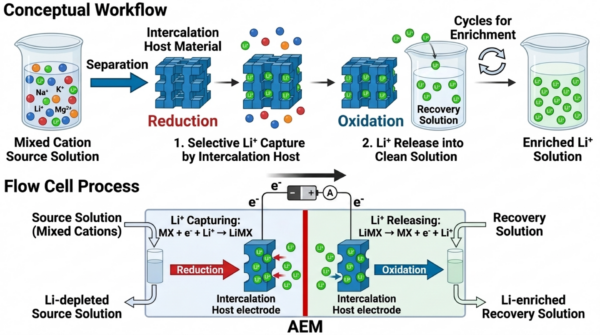
Unlike conventional recovery methods that rely heavily on chemical reagents, solvent extraction, or adsorption materials, the process uses electricity to selectively capture lithium ions within a specially engineered electrode material. The process operates in two stages: lithium capture and lithium release. During capture, lithium ions are inserted into the crystal structure of the electrode, while during release they are transferred into a clean recovery solution, producing a concentrated lithium stream that can subsequently be converted into battery-grade lithium carbonate or lithium hydroxide.
Selective and Low-Energy Lithium Recovery
A key advantage of the technology is its high selectivity. The engineered electrode materials preferentially accommodate lithium ions even in the presence of other metals and impurities commonly found in battery recycling streams, including sodium, potassium, magnesium, calcium, nickel, cobalt, manganese, and aluminium. This enables lithium recovery from complex feedstocks while reducing the need for extensive pre-treatment.
The technology has been demonstrated using real industrial solutions within European research projects. Laboratory validation achieved lithium adsorption capacities of approximately 18–26 mg Li per gram of electrode material, with energy consumption as low as 7–11 Wh per mole of recovered lithium. The process has also been tested across different solution chemistries, lithium concentrations, pH conditions, and impurity levels, demonstrating its potential for integration into battery recycling, mining, and industrial wastewater treatment processes. Because electricity is the primary driving force, the process can also be powered by renewable energy.
Industrial Scale-Up and Circular Battery Applications
The technology is currently at the lab validation stage, corresponding to approximately TRL 4–5. The next development phase will focus on increasing electrode surface area, improving throughput through modular multi-cell stack configurations, enhancing automation, and validating long-term operation under industrial conditions.
By recovering high-purity lithium from existing waste and industrial streams, electrochemical ion pumping can contribute to a more circular European battery value chain, reduce waste and chemical consumption, and strengthen the security of critical raw material supplies. Leitat is seeking pilot developers, battery recyclers, hydrometallurgical operators, flow-cell manufacturers, strategic investors, and public-private funding partners to accelerate industrial demonstration and commercialization.